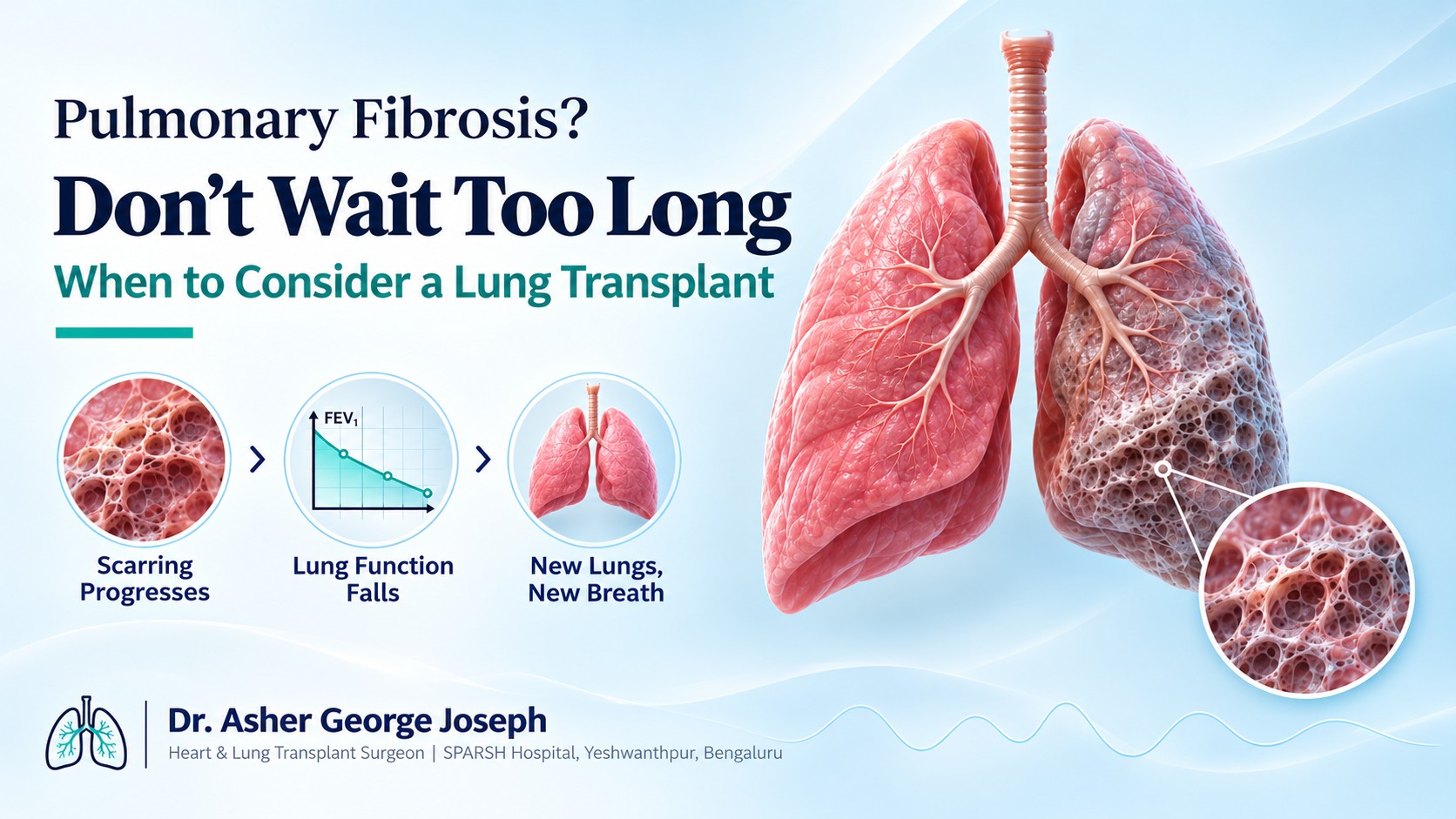
Ramesh, a 58-year-old retired bank manager from Mysuru, was told he had “lung fibrosis” four years ago. He started his antifibrotic tablets, cut down on his evening walks, and his family settled into a routine of wait and watch. Then came a chest infection, a 10-day hospital stay and an oxygen cylinder that never went back. When his daughter finally asked, “What about a lung transplant?”, the answer was painful: he had become too weak to be a safe candidate.
Ramesh is not one real patient. He is a composite of many families we meet, and his story is shared so that yours can end differently. Because the hardest truth about pulmonary fibrosis and lung transplant is this: most people who miss their chance do not miss it because transplant was impossible. They miss it because nobody started the conversation early enough.
This article explains, in plain language, what pulmonary fibrosis does to the lungs, why timing matters so much, the specific warning signs that should trigger a transplant evaluation, and what you can do this month to keep the door open.
- Interstitial lung disease (ILD), including pulmonary fibrosis, is the most common reason for lung transplant in India.
- International guidelines advise that people with certain types of fibrosis should be referred for a transplant evaluation at diagnosis, regardless of how well they feel.
- Referral is not the same as surgery. It simply puts a transplant team on your side early, while you are strong enough to benefit.
- Antifibrotic medicines slow fibrosis, but they do not reverse it. Transplant evaluation and medical treatment work best together, not as either-or choices.
- Falling lung function, needing oxygen, a shorter walking distance or a hospital stay for breathing are signals to act now.
What Pulmonary Fibrosis Actually Does to Your Lungs
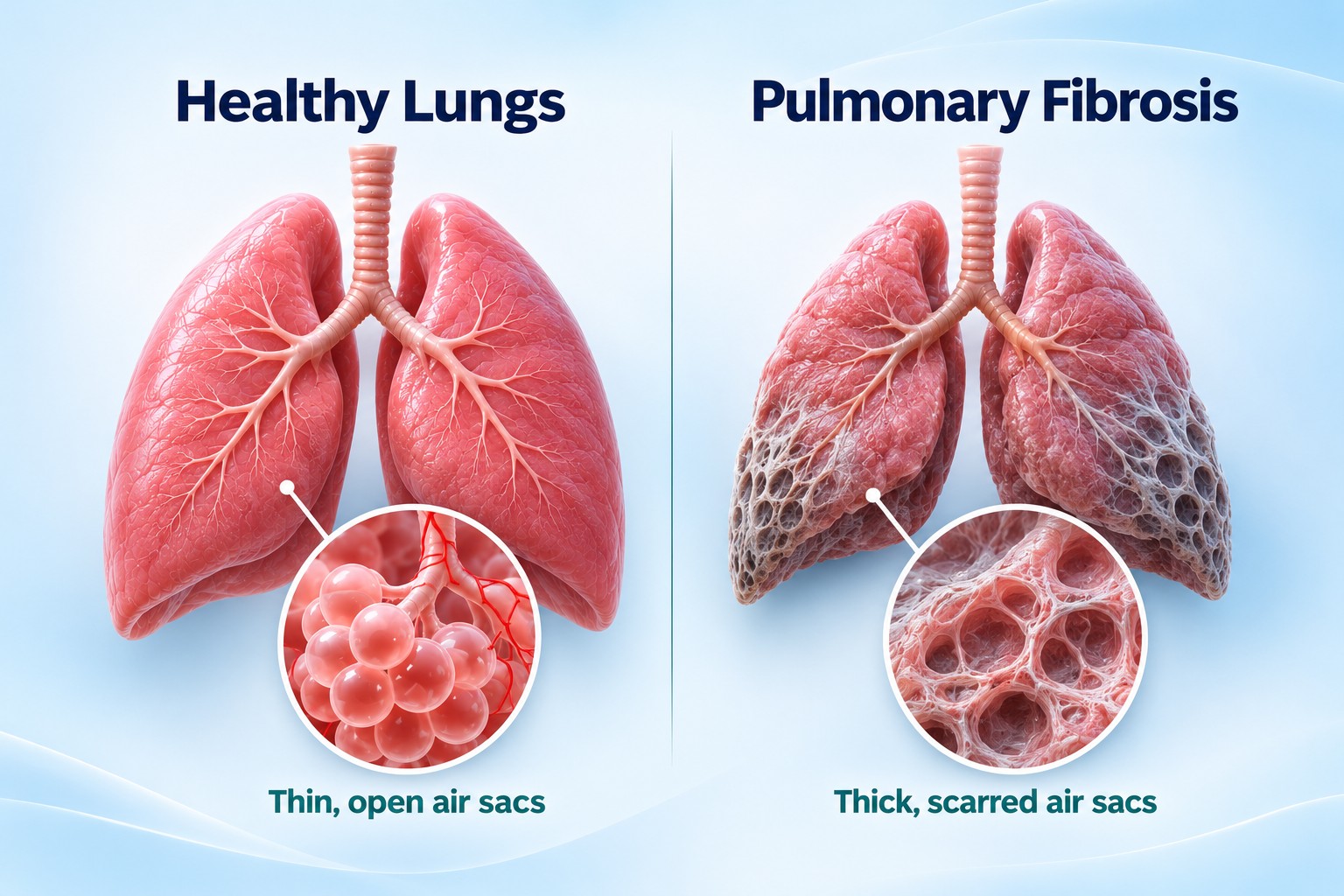
Think of healthy lungs as a sponge made of about 300 million tiny, balloon-like air sacs called alveoli. Their walls are thinner than tissue paper, which lets oxygen pass easily into the blood.
In pulmonary fibrosis, those delicate walls slowly thicken and scar. The sponge becomes stiff, like a sponge that has been left out to dry. Each breath takes more effort, and less oxygen gets through. On a CT scan, advanced scarring can look like a honeycomb, often starting at the bottom and outer edges of both lungs.
“Pulmonary fibrosis” is an umbrella term. It belongs to a larger family called interstitial lung diseases (ILDs), which includes:
- Idiopathic pulmonary fibrosis (IPF): scarring with no identifiable cause, usually after the age of 60.
- Connective tissue disease ILD: linked to rheumatoid arthritis, scleroderma or similar conditions.
- Hypersensitivity pneumonitis: triggered by long-term exposure to things like bird droppings, moulds or certain dusts.
- Occupational ILD: such as silicosis in stone, quarry and construction workers.
- Post-COVID pulmonary fibrosis: lasting lung scarring after severe COVID-19 pneumonia.
The “Transplant Window”: Why Timing Is Everything
Here is the part most families are never told. A lung transplant is a major operation. To get through it and recover well, your body needs enough strength, muscle and reserve. That creates a window of time:
Rarely the real problem. If your disease is stable, the team simply monitors you and plans ahead. Nobody operates before it is needed.
The common problem. Severe weakness, heavy oxygen needs, frailty or new complications can make surgery too risky.
Fibrosis is also unpredictable. Some people stay stable for years. Others decline suddenly, especially after an acute exacerbation, a rapid flare that can happen without warning. Studies of IPF have historically reported a median survival of around three to five years from diagnosis without transplant, although antifibrotic medicines have improved this for many patients.
Because no doctor can reliably predict who will decline quickly, the International Society for Heart and Lung Transplantation (ISHLT) recommends early referral. Their consensus advice is that people with fibrosis of the usual interstitial pneumonia (UIP) or fibrotic NSIP pattern should be referred regardless of their lung function.
7 Signs It Is Time to Ask About a Lung Transplant Evaluation
These signs are based on the ISHLT referral and listing guidance for interstitial lung disease, translated into everyday language. If even one applies to you, raise it with your pulmonologist at your next visit.
1. Your CT or biopsy shows a UIP or fibrotic pattern
This alone is a reason for referral, even if you feel fine.
2. Your breathing test numbers have dropped below key levels
A forced vital capacity (FVC) below 80% of predicted, or a diffusion capacity (DLCO) below 40%, is a referral threshold.
3. Your FVC has fallen by 10% or more in six months
Your pulmonologist tracks this on your lung function report. A drop of this size is a strong signal that the disease is progressing.
4. You need oxygen, even only while walking
Any oxygen requirement, including during exertion, is a referral trigger. Many people delay this conversation because they feel “only a little breathless”.
5. Your six-minute walk test is getting worse
Oxygen dropping below 88% during the test, walking less than 250 metres, or losing more than 50 metres in six months all matter.
6. You have been hospitalised for breathing problems
An admission for an exacerbation, a collapsed lung (pneumothorax) or worsening breathlessness is a warning that time may be shorter than expected.
7. Your doctor mentions pulmonary hypertension
When scarring raises pressure in the lung blood vessels, the right side of the heart begins to strain. This is a sign of advanced disease.
If you are breathless at rest, cannot complete a sentence, have lips or fingertips turning blue, or your oxygen saturation stays below your doctor’s target despite oxygen, seek emergency care first. Transplant planning comes after you are safe.
Common Myths That Quietly Delay Referral
Fact: Nintedanib and pirfenidone are important. In clinical trials they slowed the yearly decline in lung function by roughly half. But they do not repair scar tissue. Medicines and transplant evaluation should run in parallel.
Fact: Referral starts a relationship. Many patients are evaluated, found to be stable, and simply followed up. Listing happens only when the disease shows it is needed.
Fact: Age is one factor, not the deciding one. Overall fitness, muscle strength, heart and kidney health, and other conditions matter as much. Our lung transplant eligibility guide explains this in detail.
Fact: Fibrosis often shows itself first during activity. A resting reading can look normal while oxygen drops sharply on the stairs.
Post-COVID Fibrosis, Silicosis and Other ILDs in India
India’s lung transplant experience is shaped heavily by fibrosis. A review of Indian lung transplant recipients found that interstitial lung disease accounted for about two-thirds of all transplants. After the pandemic, doctors across South India also reported a rise in transplants for post-COVID lung scarring.
If your fibrosis followed severe COVID-19, a few things are different. Some post-COVID scarring improves over the first months, so your team will usually watch for a period before deciding. However, if you remain on high oxygen or are worsening, an early opinion from a transplant centre is wise, because these patients can deteriorate quickly while waiting.
For people with silicosis, rheumatoid arthritis ILD or scleroderma ILD, the same principle applies: if breathing, oxygen needs or lung function are getting worse despite appropriate treatment, it is time for a transplant opinion.
What Actually Happens at a Lung Transplant Evaluation
Families often imagine a single dramatic appointment. In reality, an evaluation is a structured series of tests, usually completed over several days, to answer two questions: Do you need a transplant? and Can you safely get through one?
| Area checked | Typical tests | Why it matters |
|---|---|---|
| Lungs | Lung function tests, six-minute walk, high-resolution CT | Confirms severity and rate of decline |
| Heart | Echocardiogram, sometimes coronary angiography and right heart catheterisation | Fibrosis can strain the heart; coronary disease must be treated |
| Kidneys, liver, bones | Blood tests, bone density scan | Anti-rejection medicines affect these organs |
| Infection and cancer screening | Blood tests, age-appropriate screening | Hidden problems must be treated before transplant |
| Nutrition and strength | Weight, muscle mass, frailty assessment | Strength predicts recovery |
| Support and readiness | Meetings with coordinator, counsellor, social worker | Recovery needs a committed caregiver and plan |
At the end, the team will tell you one of three things: you are a candidate and should be listed now, you are a candidate but not yet sick enough to list, or there are issues to fix first. Each of these is useful information. If ECMO support ever becomes necessary as a bridge, our article on when ECMO is used before lung transplant explains how it works.
What You Can Do This Month
- Ask for your numbers. Request copies of your last three lung function reports and six-minute walk tests. Look at the FVC and DLCO trend.
- Ask one direct question: “Should I be referred to a lung transplant centre now, even just for a first opinion?”
- Stay active. Join a pulmonary rehabilitation programme if available. Muscle strength is one of the most powerful predictors of a good transplant outcome.
- Stop smoking completely, including bidis and hookah. Transplant centres require it.
- Protect your weight. Both undernutrition and obesity raise surgical risk. Ask for a dietitian review.
- Get vaccinated against influenza, pneumococcus and COVID-19 as advised by your doctor.
- Talk as a family. Discuss who will be the main caregiver and how finances might be planned.
Living with pulmonary fibrosis or ILD?
A transplant evaluation does not commit you to surgery. It gives you a clear picture of where you stand and a team that is ready when you need them. Dr. Asher George Joseph is a heart and lung transplant surgeon at SPARSH Hospital, Yeshwanthpur, Bengaluru, trained in cardiothoracic transplantation and mechanical circulatory support in Manchester, UK.
Frequently Asked Questions
Is lung transplant the only cure for pulmonary fibrosis?
For advanced, progressive pulmonary fibrosis, lung transplant is currently the only treatment that replaces the scarred lungs. Antifibrotic medicines slow the disease, and oxygen and rehabilitation improve daily life, but none of them reverse established scarring.
When should someone with IPF be referred for lung transplant?
International ISHLT guidance recommends referral at the time of diagnosis for people with a UIP or fibrotic NSIP pattern, regardless of lung function. Referral is also advised if FVC is below 80%, DLCO below 40%, or if you need oxygen or have breathing limitation.
Can I continue antifibrotic medicines while being evaluated for transplant?
Yes. In most cases, antifibrotic treatment continues during evaluation and while on the waiting list. Your transplant and lung teams will coordinate any changes close to surgery.
Is single or double lung transplant better for pulmonary fibrosis?
Both are performed for fibrosis. Registry data show double lung transplant is associated with longer median survival overall, but single lung transplant may be considered in selected older patients. The choice is individualised.
How long can you live after a lung transplant for pulmonary fibrosis?
International registry data show median survival after lung transplant of around six years overall, with many patients living well beyond ten years. Outcomes depend on age, overall health, the type of transplant and close follow-up care.
Does post-COVID lung fibrosis need a transplant?
Not always. Some post-COVID scarring improves in the months after illness. Patients who remain on high oxygen or keep worsening should get an early transplant opinion so options are not lost.
This article is for general education and does not replace a personal consultation. Patient stories are composites, shared to protect privacy.
- Leard LE, et al. Consensus document for the selection of lung transplant candidates: an update from the ISHLT. J Heart Lung Transplant. 2021.
- Referral indications and listing criteria for ILD, summarised in J Thorac Dis. 2021;13(9):5556–5571.
- Richeldi L, et al. Idiopathic pulmonary fibrosis. Lancet. 2017;389:1941–1952.
- Lung Transplantation for Advanced Lung Failure in India: Current Scenario and Future Directions. IMA journal review, 2022.
- ISHLT International Thoracic Organ Transplant Registry reports.