For some patients with advanced heart or lung failure, the body can deteriorate faster than a suitable donor organ becomes available.
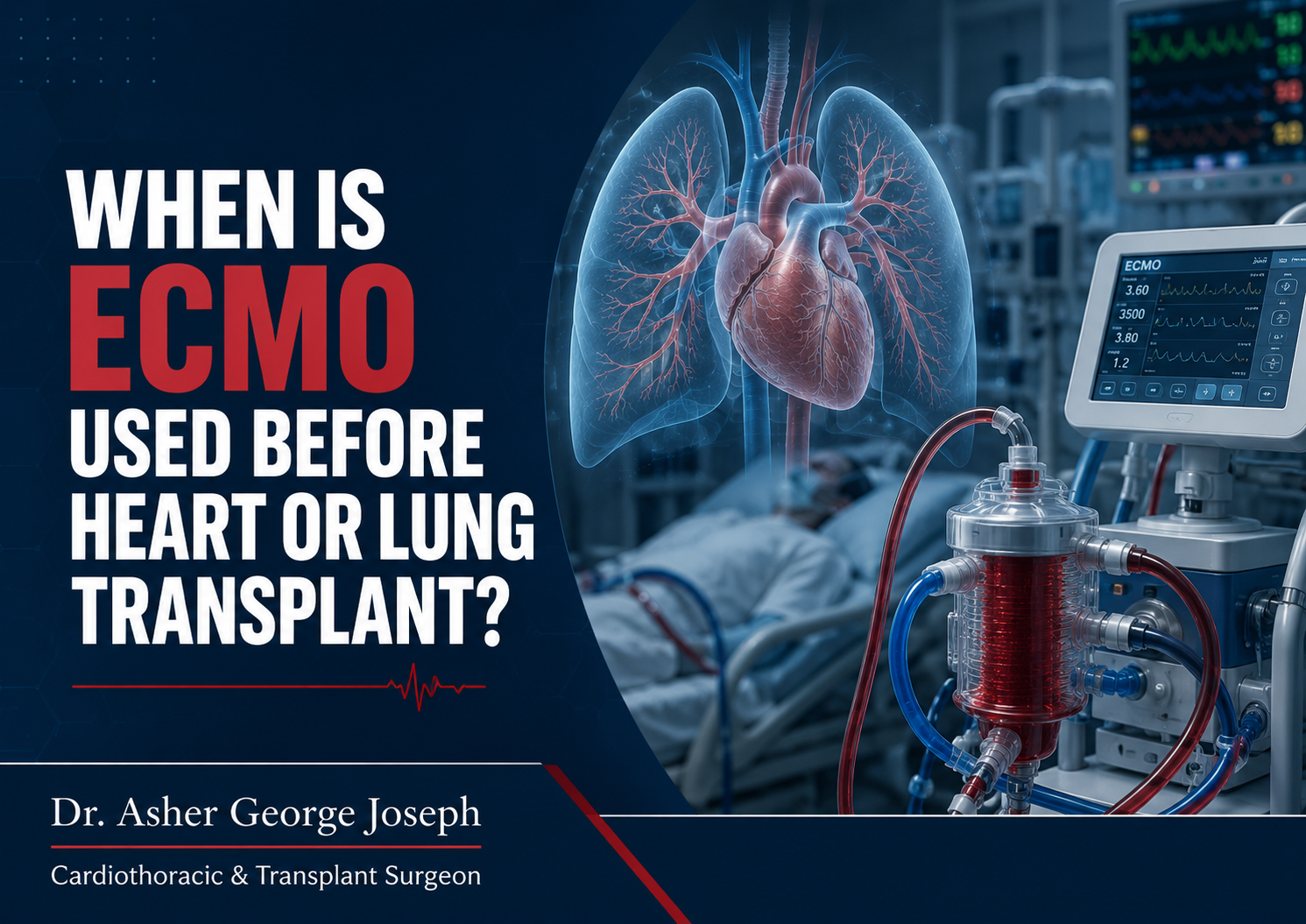
In these critical situations, doctors may consider ECMO—Extracorporeal Membrane Oxygenation—as temporary life support while the patient is evaluated for transplantation or waits for a donor organ.
ECMO does not replace a heart or lung permanently. Instead, it can temporarily support circulation, oxygenation, or both, giving the medical team valuable time to determine the next step.
One of the most common questions families ask is:
“If the heart or lungs are failing, when does ECMO become necessary before transplant?”
The answer depends on how severe the organ failure is, whether other treatments are still working, the patient’s transplant eligibility, and whether the problem may recover without transplantation.
What Is ECMO?
ECMO is an advanced form of mechanical life support.
Blood is removed from the body through large tubes called cannulas. It then passes through an artificial membrane that:
- Adds oxygen to the blood
- Removes carbon dioxide
- In some forms, helps circulate blood through the body
The blood is then returned to the patient.
ECMO is generally used in an intensive care setting and requires a highly experienced multidisciplinary team.
Why Is ECMO Sometimes Needed Before Transplant?
Patients waiting for heart or lung transplantation can sometimes deteriorate suddenly.
Despite maximum medicines, ventilator support or other treatments, the patient’s heart or lungs may no longer be able to provide adequate circulation or oxygen to vital organs.
At that point, ECMO may be considered to:
- Stabilize the patient
- Maintain oxygen delivery
- Support blood circulation
- Protect the brain, kidneys and other organs
- Allow time for transplant assessment
- Provide support while waiting for a donor
- Allow doctors to determine whether recovery is still possible
This is why ECMO is often described as a bridge rather than a definitive treatment.
What Does “Bridge to Transplant” Mean?
A bridge to transplant means using temporary mechanical support to keep a patient stable until transplantation can take place.
For example, a patient with end-stage lung disease may become unable to maintain oxygen levels even with advanced ventilator support.
If the patient has already been evaluated and accepted for lung transplantation, ECMO may sometimes be used while the team waits for suitable donor lungs.
Similarly, a patient with severe heart failure or cardiogenic shock may need circulatory support while awaiting heart transplantation.
ECMO Can Serve More Than One Purpose
ECMO may be used as:
Bridge to Recovery
The medical team believes the heart or lungs may recover sufficiently, allowing ECMO to be removed without transplant.
Bridge to Decision
The patient is critically ill, and doctors need time to determine:
- Whether recovery is possible
- Whether transplantation is appropriate
- Whether another mechanical support device should be used
Bridge to Transplant
The patient is considered a transplant candidate and ECMO provides temporary support while a suitable donor organ is awaited.
Bridge to Another Mechanical Support Device
In severe heart failure, ECMO may sometimes stabilize a patient before transition to longer-term mechanical circulatory support such as an LVAD.
Which Type of ECMO Is Used?
There are two major forms of ECMO.
VV-ECMO: Mainly Supporting the Lungs
Veno-venous ECMO, or VV-ECMO, primarily supports oxygenation and carbon dioxide removal.
It is used when the heart is functioning adequately but the lungs cannot provide sufficient gas exchange.
VV-ECMO may be considered in patients with severe respiratory failure awaiting lung transplantation.
VA-ECMO: Supporting the Heart and Circulation
Veno-arterial ECMO, or VA-ECMO, supports both blood circulation and oxygenation.
It may be used when the heart cannot pump enough blood to maintain adequate circulation.
Examples include:
- Severe cardiogenic shock
- Advanced heart failure
- Acute deterioration while awaiting heart transplant
- Severe right-heart failure associated with pulmonary hypertension
- Selected heart–lung failure situations
When Is ECMO Considered Before Heart Transplant?
ECMO may be considered when a patient with advanced heart disease develops severe circulatory failure despite maximal treatment.
Possible situations include:
- End-stage heart failure with cardiogenic shock
- Very low cardiac output
- Severe blood-pressure instability
- Failure of medicines to maintain circulation
- Life-threatening deterioration while awaiting transplantation
- Severe ventricular failure after a major cardiac event
- Failure of other temporary mechanical support strategies
The aim is to restore enough blood flow to protect vital organs while the transplant team determines the next step.
What Is Cardiogenic Shock?
Cardiogenic shock occurs when the heart is unable to pump enough blood to meet the body’s needs.
Patients may develop:
- Very low blood pressure
- Cold hands and feet
- Reduced urine output
- Altered consciousness
- Severe breathlessness
- Kidney dysfunction
- Liver dysfunction
- Increasing lactate levels
When medicines and conventional treatments are not enough, mechanical circulatory support—including ECMO—may sometimes be required.
Is ECMO Always the First Mechanical Support Option?
No.
Several forms of temporary mechanical circulatory support are available.
Depending on the clinical situation, the team may consider:
- Intra-aortic balloon pump
- Impella
- Temporary ventricular assist devices
- ECMO
The correct choice depends on:
- Which ventricle is failing
- Blood pressure
- Oxygenation
- Severity of shock
- Presence of lung failure
- Organ function
- Expected recovery
- Transplant eligibility
ECMO is generally reserved for patients with severe life-threatening heart or lung failure requiring substantial support.
When Is ECMO Used Before Lung Transplant?
Some patients with advanced lung disease gradually worsen despite maximum medical treatment and oxygen support.
Others deteriorate suddenly.
ECMO may be considered when the lungs are no longer able to maintain adequate oxygen and carbon dioxide levels and conventional treatment is insufficient.
This can occur in patients with conditions such as:
- Advanced pulmonary fibrosis
- Severe pulmonary hypertension
- Cystic fibrosis or bronchiectasis
- Selected end-stage obstructive lung diseases
- Other irreversible advanced lung disorders
The patient’s overall transplant eligibility remains crucial.
Can ECMO Be Used Instead of a Ventilator?
Sometimes ECMO allows doctors to reduce the intensity of mechanical ventilation.
In selected lung transplant candidates, this can be valuable because prolonged aggressive ventilation can cause:
- Lung injury
- Muscle weakness
- Infection
- Sedation-related complications
- Reduced ability to participate in rehabilitation
Some specialized transplant centers use awake ECMO, where carefully selected patients remain awake, participate in physiotherapy and may even walk while awaiting transplantation.
This approach is highly specialized and is not suitable for every patient.
What Is Ambulatory ECMO?
Ambulatory ECMO refers to carefully managed ECMO support that allows selected patients to remain physically active rather than continuously sedated and bed-bound.
The aim is to maintain:
- Muscle strength
- Mobility
- Nutrition
- Respiratory conditioning
- Overall transplant fitness
This can be particularly important because severe deconditioning before transplantation may make postoperative recovery more difficult.
However, ambulatory ECMO requires specialized cannulation techniques, intensive monitoring and an experienced ECMO-transplant team.
ECMO in Severe Pulmonary Hypertension
Severe pulmonary hypertension places enormous strain on the right side of the heart.
Some patients eventually develop:
- Severe right-heart failure
- Low blood pressure
- Poor organ perfusion
- Progressive breathlessness
- Recurrent hospital admissions
If deterioration becomes life-threatening while the patient is being considered for lung or heart–lung transplantation, mechanical support may sometimes be required.
VA-ECMO can provide circulatory support in selected patients with severe pulmonary hypertension and right-heart failure.
ECMO Before Heart–Lung Transplant
A small group of patients have severe combined heart and lung disease that cannot be adequately treated with transplantation of one organ alone.
In selected cases, heart–lung transplantation may be considered.
If both respiratory and circulatory function deteriorate critically before transplantation, ECMO may be used as a temporary bridge in carefully selected patients.
Because these cases are extremely complex, decisions are individualized by a specialist transplant team.
Does Starting ECMO Automatically Mean the Patient Will Receive a Transplant?
No.
This is an important point for patients and families.
ECMO can stabilize a patient, but transplantation still depends on whether the patient meets transplant criteria.
The team must evaluate factors including:
- Underlying diagnosis
- Reversibility of the disease
- Brain function
- Kidney and liver function
- Active infection
- Other major illnesses
- Frailty
- Nutritional status
- Rehabilitation potential
- Ability to tolerate transplant surgery
- Availability of an appropriate donor organ
ECMO cannot reverse every complication or make every critically ill patient eligible for transplantation.
Why Timing Is So Important
One of the biggest challenges is determining when ECMO should be started.
Starting too early can expose a patient to unnecessary risks.
Starting too late may mean that irreversible damage has already occurred to:
- Brain
- Kidneys
- Liver
- Other vital organs
Transplant teams therefore closely monitor whether the patient’s condition is deteriorating despite conventional treatment.
Ideally, mechanical support is considered before irreversible multi-organ failure occurs.
What Happens After a Patient Is Placed on ECMO?
Once ECMO begins, the team continuously evaluates the patient.
Monitoring may include:
- Blood pressure
- Oxygen levels
- Blood gases
- Heart function
- Kidney function
- Liver function
- Neurological status
- Blood clotting
- Infection markers
- ECMO circuit function
Doctors also continually reassess whether the patient is:
- Recovering
- Remaining stable
- Deteriorating
- Ready for transplantation
- Suitable for another form of long-term support
What Are the Risks of ECMO?
ECMO can provide essential temporary support, but it is a major intensive-care therapy with important risks.
Potential complications include:
Bleeding
Blood-thinning medication is often required to reduce clot formation in the ECMO circuit.
This can increase bleeding risk.
Blood Clots
Clots can develop despite anticoagulation and may affect the ECMO circuit or the patient.
Stroke
Both bleeding and clotting complications can potentially affect the brain.
Infection
Large cannulas and prolonged intensive-care treatment can increase infection risk.
Limb Circulation Problems
In certain types of VA-ECMO, blood flow to a leg can sometimes be affected.
Kidney or Other Organ Dysfunction
Many patients requiring ECMO are already critically ill, and organ dysfunction can continue despite support.
Mechanical Complications
The ECMO circuit itself requires constant monitoring for technical problems.
For this reason, ECMO should be managed by teams specifically experienced in advanced mechanical circulatory and respiratory support.
How Long Can a Patient Stay on ECMO While Waiting for Transplant?
There is no single maximum duration that applies to every patient.
Some patients require support for a relatively short period, while others may remain on ECMO considerably longer.
The duration depends on:
- Clinical stability
- Complications
- Recovery potential
- Organ function
- Donor availability
- Type of ECMO
- Transplant status
The team evaluates the benefits and risks continuously.
Can a Patient Recover Without Transplant After Starting ECMO?
Yes, in some situations.
ECMO is sometimes initiated when doctors do not yet know whether the heart or lungs will recover.
If sufficient recovery occurs, the patient may be gradually weaned from ECMO without transplantation.
This is why ECMO may initially be described as a bridge to decision.
ECMO vs LVAD Before Heart Transplant
ECMO and LVADs serve different roles.
ECMO
Usually provides relatively short-term emergency support for very sick or unstable patients.
LVAD
A left ventricular assist device can provide longer-term mechanical support for patients with severe left-heart failure.
For some heart transplant candidates, ECMO may first stabilize the patient and an LVAD may later be considered if longer-term support is required.
Not every patient follows this pathway.
Who Decides Whether ECMO Is Appropriate?
The decision is multidisciplinary.
The team may include:
- Cardiothoracic and transplant surgeons
- Heart failure cardiologists
- Lung transplant physicians
- Critical-care specialists
- ECMO specialists
- Anaesthesiologists
- Perfusionists
- Rehabilitation specialists
- Infectious-disease specialists
- Transplant coordinators
The decision is based not only on whether ECMO can technically be started, but on whether it offers a realistic pathway toward recovery, durable mechanical support or transplantation.
Frequently Asked Questions
Is ECMO a replacement for the heart or lungs?
No. ECMO provides temporary support while the underlying condition is treated or while another long-term plan is made.
Does ECMO cure heart failure?
No. ECMO can support circulation, but it does not cure chronic end-stage heart failure.
Can ECMO keep someone alive until a donor heart becomes available?
In selected transplant candidates, ECMO can provide temporary circulatory support while awaiting transplantation, but its suitability and duration vary significantly between patients.
Can ECMO be used while waiting for a lung transplant?
Yes. Selected patients with severe respiratory failure may be supported with ECMO while awaiting suitable donor lungs.
Can patients be awake while on ECMO?
Some carefully selected patients can remain awake and participate in rehabilitation while receiving ECMO, particularly in experienced transplant centers.
Is ECMO the same as a ventilator?
No. A ventilator moves air into and out of the lungs. ECMO oxygenates blood outside the body and can temporarily perform part of the lungs’ gas-exchange function.
Does every transplant patient who becomes critically ill need ECMO?
No. ECMO is reserved for selected patients when conventional treatments cannot provide adequate heart or lung support.
Can ECMO be used if both the heart and lungs are failing?
Yes. VA-ECMO can support circulation as well as oxygenation and may be considered in selected patients with combined cardiopulmonary failure.
ECMO Is a Bridge, Not the Final Destination
ECMO is one of the most advanced forms of temporary life support available today.
For carefully selected patients with severe heart or lung failure, it can provide something extremely important:
time.
Time for the heart or lungs to recover.
Time to determine whether transplantation is appropriate.
Time to stabilize failing organs.
And in selected transplant candidates, time for a suitable donor organ to become available.
But ECMO is not appropriate for every critically ill patient. Successful use depends on careful patient selection, appropriate timing and close coordination between ECMO, critical-care and transplant teams.
When advanced heart or lung disease is progressing despite conventional treatment, early referral to a transplant center can allow these options to be discussed before irreversible organ failure develops.
Dr. Asher George Joseph
Cardiothoracic & Transplant Surgeon
Advanced surgical care for complex heart and lung disease, including cardiac surgery, advanced heart failure, ECMO support, heart transplantation, lung transplantation and combined cardiothoracic transplant care.
Medical Disclaimer: This article is for general patient education and does not replace individual medical advice. ECMO and transplant decisions depend on the patient’s diagnosis, severity of illness, organ function and overall transplant eligibility and should be made by an experienced multidisciplinary team.