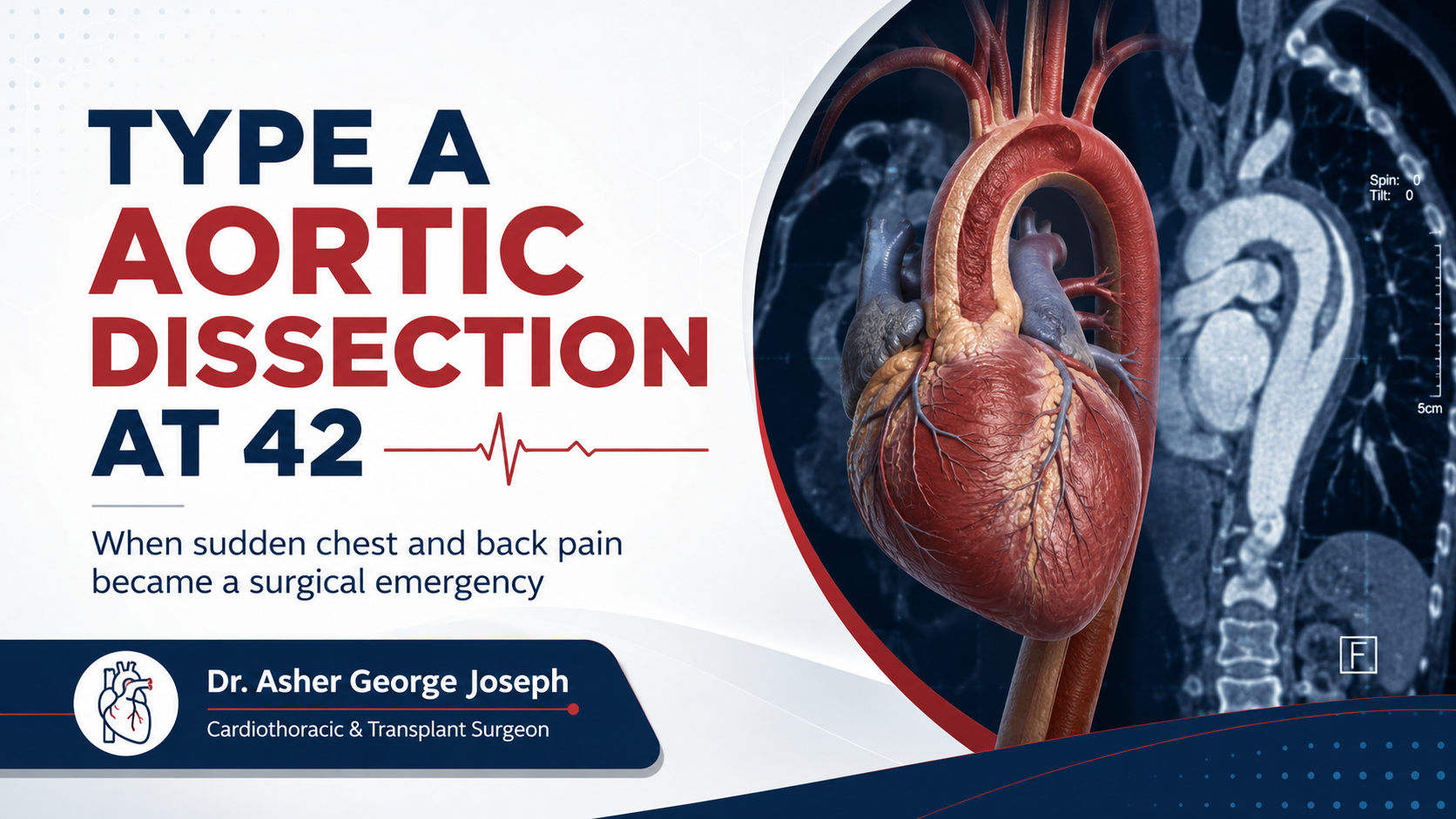
A 42-year-old patient. Sudden chest pain. Severe back pain. One CT scan—and a diagnosis that required immediate action.
What initially appeared to be a symptom that could have several possible causes turned out to be one of the most serious emergencies in cardiovascular medicine: an acute Type A aortic dissection.
The patient underwent complex emergency surgery—a Bentall procedure with replacement of the ascending aorta.
He recovered well, was discharged from hospital, and continues to do well on regular follow-up.
This case is not simply about a technically demanding operation. It highlights something equally important:
In acute aortic dissection, recognizing the symptoms, reaching the right diagnosis quickly, and intervening at the right time can completely change the course of the patient’s care.
It Started With Sudden Chest and Back Pain
The patient, aged 42, presented with acute chest and back pain.
Chest pain immediately raises concern for a heart attack, but the heart is not the only cardiovascular structure capable of producing a life-threatening emergency.
Running directly from the heart is the aorta—the largest artery in the body.
It carries oxygen-rich blood from the heart to the brain, kidneys, abdominal organs, arms, legs, and almost every major tissue in the body.
When the wall of this artery suddenly develops a tear, the situation can become critical very quickly.
That is exactly what the CT scan revealed.
The Diagnosis: Acute Type A Aortic Dissection
CT angiography confirmed a Type A aortic dissection.
An aortic dissection occurs when a tear develops in the inner layer of the aortic wall.
Blood enters through this tear and begins travelling between the layers of the artery.
Instead of remaining within the normal channel of the aorta, blood can create a second pathway inside the vessel wall.
This can:
- weaken the aorta further,
- reduce blood supply to vital organs,
- affect the aortic valve,
- compromise coronary blood flow,
- cause bleeding around the heart,
- lead to rupture,
- or result in neurological and organ complications.
The term “Type A” is particularly important.
It means that the dissection involves the ascending aorta—the section immediately next to the heart.
That location makes it a surgical emergency in most cases.
Why Type A Dissection Cannot Usually Wait
Some cardiovascular diseases allow doctors time to perform multiple investigations, discuss different options, optimize medical conditions, and plan treatment over days or weeks.
Acute Type A aortic dissection is very different.
Once the ascending aorta has dissected, the patient may deteriorate rapidly.
The dissection can affect structures located only centimetres away, including:
- the aortic valve,
- coronary arteries,
- arteries supplying the brain,
- and the sac surrounding the heart.
This is why management becomes a race against progression of the disease.
The question is no longer:
“Should this be treated?”
The more immediate question becomes:
“What operation will restore the safest possible circulation before serious complications develop?”
The Surgical Decision: Bentall Procedure With Ascending Aorta Replacement
In this case, the patient underwent a Bentall procedure along with replacement of the ascending aorta.
This is a major aortic operation used when disease involves the aortic root and adjacent ascending aorta in a way that requires comprehensive reconstruction.
A Bentall operation generally involves replacing the diseased aortic root and aortic valve using a valved conduit, while the coronary arteries are carefully reimplanted into the reconstructed aorta.
The damaged ascending aorta can then be replaced with a synthetic vascular graft where required.
The exact surgical strategy always depends on the individual patient’s anatomy and the extent of the dissection.
Not every Type A dissection requires exactly the same operation.
Some patients may undergo:
- isolated ascending aortic replacement,
- hemiarch repair,
- aortic root repair,
- valve-sparing root surgery,
- Bentall procedure,
- or more extensive arch reconstruction.
The operation must be tailored to the disease found in that particular patient.
Why Is This Surgery So Complex?
Emergency Type A dissection repair is among the most challenging procedures in cardiothoracic surgery.
Several factors contribute to that complexity.
The Tissue Is Already Damaged
The surgeon is not operating on normal, healthy aorta.
The vessel wall has already split and may be extremely fragile.
Every reconstruction must therefore be performed with great precision.
The Operation Is Very Close to the Heart
The ascending aorta begins directly from the heart.
The aortic root is closely related to:
- the aortic valve,
- the coronary arteries,
- and the heart muscle itself.
If the dissection involves these structures, they may also require reconstruction.
Blood Supply to the Brain Must Be Protected
The arteries supplying the brain arise from the aortic arch.
If the dissection extends into this region, cerebral circulation becomes an important part of surgical planning.
Protecting neurological function is therefore one of the key priorities during complex aortic surgery.
Other Organs May Already Be at Risk
A dissection can extend down the aorta and interfere with blood flow to:
- kidneys,
- intestines,
- legs,
- spinal cord,
- or other vascular territories.
The team must assess the entire patient—not only the section of aorta visible in the chest.
The Operation Was Successful. What Happens Next?
Completing the surgery is only one part of the journey.
The early postoperative period following emergency aortic surgery requires close monitoring.
The team watches carefully for:
- bleeding,
- heart function,
- neurological changes,
- kidney function,
- blood pressure,
- rhythm disturbances,
- respiratory recovery,
- infection,
- and organ perfusion.
In this case, the patient recovered well following surgery.
He progressed satisfactorily through the postoperative period, was discharged from hospital, and continues to do well during regular follow-up.
For a complex emergency operation with recognized risks of significant morbidity and mortality, seeing the patient recover and return for follow-up in good condition is an especially meaningful outcome for the entire team.
Why Follow-Up Does Not End After Discharge
A successful repair addresses the immediate life-threatening problem.
But a patient who has experienced an aortic dissection usually requires long-term surveillance of the remaining aorta.
Follow-up may include:
- regular blood-pressure assessment,
- medications as prescribed,
- echocardiography,
- CT or MRI surveillance when indicated,
- monitoring of the remaining thoracic and abdominal aorta,
- assessment of the aortic valve and heart,
- and guidance regarding exercise and lifestyle.
This matters because the repaired segment is only one part of the entire aorta.
Depending on the extent of the original dissection, other portions of the vessel may still require observation over time.
The Most Important Lesson From This Case
Aortic dissection does not always give a long warning period.
A patient may feel well previously and then suddenly develop severe symptoms.
That makes symptom recognition extremely important.
Warning symptoms that deserve immediate evaluation include:
- sudden severe chest pain,
- sudden severe upper-back pain,
- pain extending from the chest toward the back,
- unexplained collapse or fainting,
- sudden breathlessness,
- new weakness or numbness,
- difficulty speaking,
- sudden vision changes,
- severe abdominal pain,
- or a suddenly cold or painful limb.
These symptoms can occur with several different emergency conditions.
They do not automatically mean aortic dissection.
But they should never be dismissed without appropriate medical evaluation.
“I’m Only 42. Can Aortic Dissection Really Happen This Young?”
Yes.
Aortic dissection is more common with increasing age, but younger people can also be affected.
Factors that may increase risk include:
- uncontrolled high blood pressure,
- bicuspid aortic valve,
- known enlargement of the aorta,
- certain inherited connective-tissue conditions,
- family history of aortic aneurysm or dissection,
- and some other less common aortic disorders.
However, a patient does not always have a previously diagnosed aortic condition before presenting with an acute dissection.
That is another reason the symptoms themselves matter.
Aortic Dissection Is Not the Same as a Heart Attack
Both can cause severe chest pain.
But they are different diseases.
A heart attack generally occurs when blood flow through a coronary artery becomes suddenly blocked.
An aortic dissection occurs when the wall of the aorta tears.
The treatments are very different.
This is why rapid, accurate diagnosis is so important.
The goal is not simply to identify that the patient has “cardiac chest pain.”
The team needs to determine what cardiovascular emergency is actually occurring.
What Does CT Angiography Show?
CT angiography is particularly valuable in suspected aortic dissection because it can rapidly provide a detailed view of the aorta.
It can help identify:
- the location of the initial tear,
- involvement of the ascending aorta,
- extension into the arch or descending aorta,
- the true and false channels,
- involvement of major branch vessels,
- aortic root disease,
- fluid or bleeding around the heart,
- and signs of organ malperfusion.
This information helps the surgical team plan the operation.
Frequently Asked Questions
Does every Type A aortic dissection require emergency surgery?
Most acute Type A dissections require urgent surgical assessment and are generally treated surgically because the ascending aorta is involved and serious complications can develop quickly.
Is Bentall surgery performed for every Type A dissection?
No. The surgical procedure depends on the condition of the aortic root, valve, ascending aorta and arch, as well as the extent of the dissection.
What is replaced during a Bentall procedure?
A Bentall procedure typically replaces the aortic root and valve using a valved conduit, with reimplantation of the coronary arteries. Additional ascending aortic replacement may be performed depending on the disease.
Can someone recover normally after this type of operation?
Many patients can make a meaningful recovery after successful surgery, but recovery differs from person to person and long-term follow-up remains important.
Why is blood-pressure control so important after aortic surgery?
High blood pressure increases stress on the aortic wall. Appropriate blood-pressure control helps reduce stress on the remaining aorta.
Does successful surgery mean the aorta no longer needs monitoring?
Not necessarily. Patients who have experienced an aortic dissection generally require ongoing surveillance because other portions of the aorta may remain affected or may change over time.
One Emergency. Many Decisions. One Coordinated Team.
A Type A aortic dissection is not managed by surgery alone.
Successful treatment depends on multiple teams working together:
Emergency assessment → imaging → diagnosis → anaesthesia → cardiopulmonary support → complex aortic reconstruction → intensive care → rehabilitation → long-term follow-up.
In this 42-year-old patient, the journey began with acute chest and back pain.
CT angiography identified the underlying emergency.
A Bentall procedure with ascending aorta replacement was performed.
The patient recovered well, was discharged, and remains well on regular follow-up.
Cases like this reinforce why complex aortic emergencies require both speed and precision.
Early recognition gets the patient to the right care. Accurate diagnosis defines the problem. Timely surgery gives the team the opportunity to change the outcome.
Dr. Asher George Joseph
Cardiothoracic & Transplant Surgeon
Cardiac Surgery | Complex Aortic Surgery | Advanced Heart Failure | Heart & Lung Transplantation
Patient-identifying information has been omitted. This case is shared for professional and patient education.
Medical disclaimer: The information in this article is for general educational purposes and does not replace individual medical evaluation. Sudden severe chest or back pain, collapse, breathlessness, or new neurological symptoms require immediate emergency medical assessment.