By Dr. Asher George Joseph
Heart surgery is not always just about treating blocked arteries.
Sometimes, the real challenge is much deeper.
The heart may already be weak. The kidneys may already be under stress. The patient may be breathless, tired, and unable to tolerate even simple physical activity. In such situations, surgery requires more than technical skill. It requires careful judgment, detailed planning, and a treatment approach designed specifically for that patient.
This was the case of a 62-year-old gentleman who came with complaints of exertional angina and breathlessness.
He experienced chest discomfort and difficulty breathing during activity — symptoms that many people mistakenly ignore or blame on age, weakness, or tiredness. But these symptoms can be important warning signs that the heart is struggling.
Further evaluation showed that this was a complex and high-risk cardiac case.
The First Major Concern: Heart Pumping Function Was Only 30%
One of the most important findings was that the patient’s ejection fraction was 30%.
Ejection fraction, or EF, tells us how well the heart is pumping blood. In a healthy heart, the EF is usually much higher. When the EF drops to around 30%, it means the heart’s pumping ability is significantly reduced.
This makes heart surgery more challenging because a weak heart may not tolerate surgical stress as well as a normal-functioning heart.
In such cases, the surgical team must carefully assess one crucial question:
Is the heart muscle still capable of recovery?
In this patient, further evaluation showed that the myocardium, or heart muscle, was well preserved. This was an important and positive finding.
It meant that although the heart was weak, the muscle still had recovery potential. If blood flow could be restored properly, there was a possibility that the heart function could improve after surgery.
Important Point 1
Low EF does not always mean surgery is impossible.
A weak heart needs careful evaluation. If the heart muscle is still viable, selected patients may benefit from properly planned bypass surgery.
The Second Concern: Grade 3 Diastolic Dysfunction
The patient also had Grade 3 diastolic dysfunction.
This means the heart was not relaxing properly between beats. A stiff heart can cause pressure to build up inside the heart and lungs, leading to breathlessness, fatigue, and reduced exercise capacity.
When reduced pumping function and advanced diastolic dysfunction are present together, the risk becomes higher.
In this case, the patient had both:
EF of 30%
Grade 3 diastolic dysfunction
This made surgical planning more complex.
The concern was not only whether the bypass could be performed, but whether the heart would recover well after surgery.
The Third Concern: Kidney Function Was Already Affected
Along with the heart condition, the patient also had deranged renal function before surgery.
This added another layer of risk.
In cardiac surgery, kidney protection is extremely important, especially when kidney function is already abnormal before the operation. Such patients may have a higher chance of kidney-related complications after surgery, including the possibility of requiring dialysis.
For this patient, the surgical goal was clear:
Restore blood flow to the heart.
Avoid unnecessary stress on the kidneys.
Maintain stable circulation throughout surgery.
Reduce the risk of post-operative dialysis.
This required a carefully planned surgical approach.
Important Point 2
In high-risk heart surgery, kidney protection is as important as heart protection.
When kidney function is already affected, blood pressure, fluid balance, medicines, circulation, and post-operative monitoring must be managed with extreme care.
Why Beating-Heart Bypass Surgery Was Planned
Considering the patient’s weak heart function and kidney risk, the team planned to perform the surgery without using the heart-lung machine.
This approach is called:
Off-Pump Beating-Heart Coronary Artery Bypass Grafting
In this technique, bypass surgery is performed while the heart continues beating. The heart-lung machine is avoided.
This can be helpful in selected high-risk patients because it may reduce some of the stress associated with conventional bypass surgery. However, it is technically demanding and requires experience, precision, and careful monitoring throughout the procedure.
For this patient, the decision was not routine. It was individualized.
The treatment plan was designed around his specific risks — weak heart function, advanced diastolic dysfunction, and compromised kidney function.
Important Point 3
The best surgical approach is the one that fits the patient, not just the disease.
Two patients may have similar heart blockages, but their treatment plan may be different depending on heart function, kidney status, age, overall health, and surgical risk.
The Surgery and Recovery
The patient underwent off-pump beating-heart coronary artery bypass surgery.
The surgery went well, and the patient recovered successfully.
The improvement after surgery was significant.
His ejection fraction improved from:
30% to 45%
This showed a meaningful improvement in the heart’s pumping capacity.
His diastolic dysfunction improved from:
Grade 3 to Grade 1
This suggested better relaxation of the heart and improved overall cardiac function.
Most importantly, despite having deranged kidney function before surgery, the patient did not require dialysis at any point after the operation.
His renal parameters also improved after surgery.
For a high-risk patient, this was a very encouraging outcome.
Why This Case Is Important
This case is important because it shows that high-risk does not always mean hopeless.
The patient had multiple risk factors:
Reduced heart pumping function
Grade 3 diastolic dysfunction
Deranged kidney function
Risk of post-operative kidney failure
Risk of delayed heart recovery
In some patients with such risk factors, the heart may struggle to recover after surgery. In certain situations, mechanical circulatory support may even be required to support the heart during recovery.
But in this case, careful planning, proper patient selection, and precise execution helped achieve a successful result.
The heart function improved.
The diastolic dysfunction improved.
The kidney function stabilized.
Dialysis was avoided.
This is why individualized cardiac surgical planning matters.
What Patients and Families Should Learn
Chest pain and breathlessness should never be ignored, especially when they occur during walking, climbing stairs, or routine activity.
You should seek medical evaluation if you experience:
Chest heaviness during activity
Breathlessness on exertion
Unusual fatigue
Reduced walking capacity
Swelling in the legs
Difficulty lying flat
Sudden drop in stamina
Early diagnosis gives doctors more time to evaluate the heart properly and choose the safest treatment approach.
A Human Side to This Case
For the patient and his family, this was not just about medical numbers.
It was not only about EF 30%.
It was not only about Grade 3 diastolic dysfunction.
It was not only about kidney risk.
It was about whether he could breathe better.
Whether he could walk without chest pain.
Whether dialysis could be avoided.
Whether he could recover safely after a major heart procedure.
That is the real goal of advanced cardiac surgery — not just to perform an operation, but to help the patient return to a better and more stable life.
Conclusion
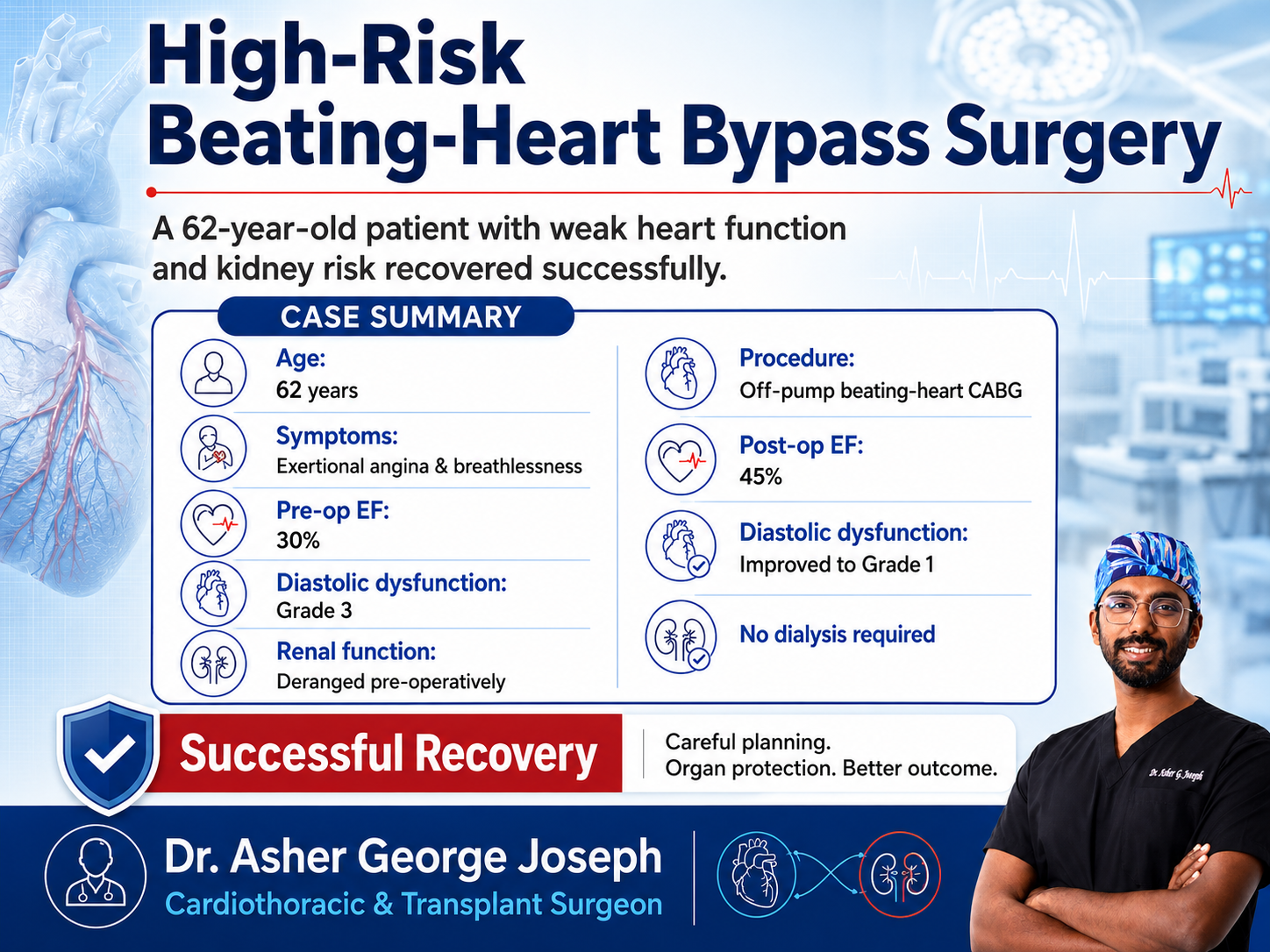
A 62-year-old gentleman with exertional angina, breathlessness, EF of 30%, Grade 3 diastolic dysfunction, and deranged renal function underwent successful off-pump beating-heart coronary artery bypass surgery.
After surgery, his EF improved to 45%, diastolic dysfunction improved to Grade 1, kidney parameters improved, and dialysis was avoided.
This case highlights an important message:
With the right evaluation, the right surgical approach, and careful execution, even complex heart patients can achieve excellent recovery.
Dr. Asher George Joseph
Cardiothoracic & Transplant Surgeon
Dr. Asher George Joseph is a Cardiothoracic & Transplant Surgeon with expertise in complex cardiac surgery, coronary artery bypass grafting, beating-heart bypass surgery, and advanced surgical care for high-risk cardiac patients.
His approach focuses on detailed evaluation, individualized surgical planning, organ-protective strategies, and precision-based cardiac care to help patients achieve the best possible outcomes in complex heart conditions.
Frequently Asked Questions
1. What is off-pump beating-heart bypass surgery?
Off-pump beating-heart bypass surgery is a type of coronary artery bypass surgery performed while the heart continues to beat. In this approach, the heart-lung machine is not used. This technique may be considered in selected high-risk patients when the surgical team wants to reduce additional stress on the body.
2. Why was beating-heart bypass surgery chosen in this patient?
This patient had weak heart pumping function, Grade 3 diastolic dysfunction, and deranged kidney function before surgery. Because of these risks, the surgical team planned an approach that could restore blood flow to the heart while reducing stress on the kidneys and overall circulation.
3. What does an ejection fraction of 30% mean?
An ejection fraction of 30% means the heart’s pumping ability is significantly reduced. The heart is not pushing out blood as effectively as it should. This can lead to symptoms like breathlessness, fatigue, reduced stamina, and chest discomfort during activity.
4. Can heart function improve after bypass surgery?
In selected patients, heart function can improve after bypass surgery, especially when the heart muscle is still viable and blood flow is successfully restored. In this case, the patient’s ejection fraction improved from 30% to 45% after surgery.
5. What is Grade 3 diastolic dysfunction?
Grade 3 diastolic dysfunction means the heart has difficulty relaxing and filling properly between beats. This can increase pressure inside the heart and lungs, leading to breathlessness and poor exercise tolerance. In this case, the dysfunction improved from Grade 3 to Grade 1 after surgery.
6. Why is kidney function important before heart surgery?
Kidney function is very important because patients with abnormal kidney parameters before surgery may have a higher risk of kidney-related complications after surgery. In some cases, dialysis may be required. That is why kidney protection becomes a major part of surgical planning.
7. Did the patient require dialysis after surgery?
No. Although the patient had deranged kidney function before surgery, he did not require dialysis at any point after the operation. His renal parameters also improved during recovery.
8. Is bypass surgery safe for patients with weak heart function?
Bypass surgery in patients with weak heart function can be high-risk, but it may still be possible in selected patients after detailed evaluation. The decision depends on heart muscle viability, kidney function, lung condition, age, overall health, and surgical risk.
9. When should a patient consult a heart specialist?
A patient should seek medical evaluation if they experience chest pain during walking, breathlessness on exertion, unusual fatigue, reduced stamina, swelling in the legs, or difficulty lying flat. These symptoms may indicate that the heart is under stress.
10. What is the key message from this case?
The key message is that even high-risk heart patients can have good outcomes when the case is evaluated properly and the surgical approach is carefully planned. With the right strategy, careful execution, and expert cardiac care, complex patients can recover successfully.