Many patients with advanced heart or lung disease meet a transplant surgeon only when they are already very unwell. By then, some options may have closed. A transplant evaluation is not the “last step” in treatment. It is a planning step. Coming early gives you more choices, and more time to use them.
In this article, we explain the warning signs that mean it is time to see a transplant surgeon, what happens during an evaluation, and why timing matters so much.
Why timing matters in heart and lung transplant
A transplant works best when the patient is still strong enough to recover well from major surgery. If the evaluation happens too late, the body may become too weak. Other organs such as the kidneys or liver may be affected, or infections and muscle loss may make surgery riskier.
Donor organs are also limited. Getting listed takes time. Tests must be done, reports reviewed and the family prepared. Starting early means you are ready when the right organ becomes available.
An early visit does not mean you will have a transplant immediately. Many patients are simply monitored, have their treatment adjusted, and are guided on when the time is right.
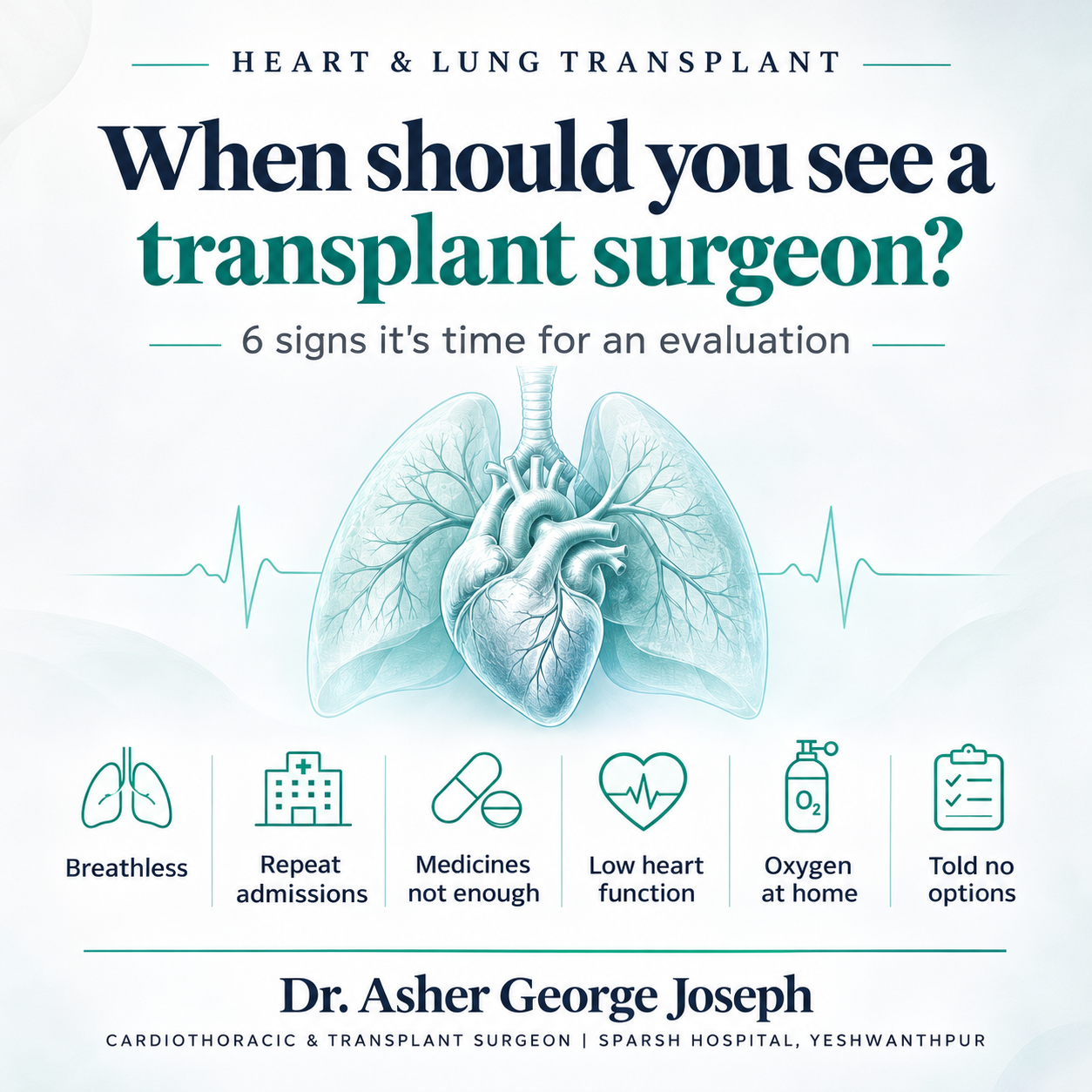
6 signs it’s time for a transplant evaluation
If you or a family member has advanced heart failure or a serious lung disease such as pulmonary fibrosis (ILD), COPD or pulmonary hypertension, talk to a transplant surgeon if you notice any of these signs:
1. You feel breathless doing simple tasks
Walking a short distance, climbing a few stairs, bathing or getting dressed leaves you out of breath. Breathlessness at rest, or needing extra pillows to sleep, is an even stronger signal.
2. You keep getting admitted to hospital
Two or more admissions in a year for heart failure or breathing problems show that the disease is progressing. Each admission can take a toll on the body.
3. Your medicines are no longer enough
You are taking all the recommended medicines, but your symptoms keep getting worse. Your doses keep going up, or you need intravenous medicines to stay stable.
4. Your heart or lung function keeps falling
Your echo shows a very weak heart pump, or your lung function tests (such as FVC or DLCO) and walking test results keep dropping over time.
5. You need oxygen at home
You need oxygen during the day, at night or while walking, and your oxygen requirement keeps rising.
6. You have been told “nothing more can be done”
This is one of the most important reasons to seek a transplant opinion. Often, there are still options, such as a transplant or advanced support devices, that have not yet been considered.
What happens at your first visit?
The first consultation is a conversation, not a commitment. Here is what usually happens:
- Review of your history: we go through your reports, scans, medicines and hospital records.
- Honest assessment: we tell you whether a transplant may be right for you, and when.
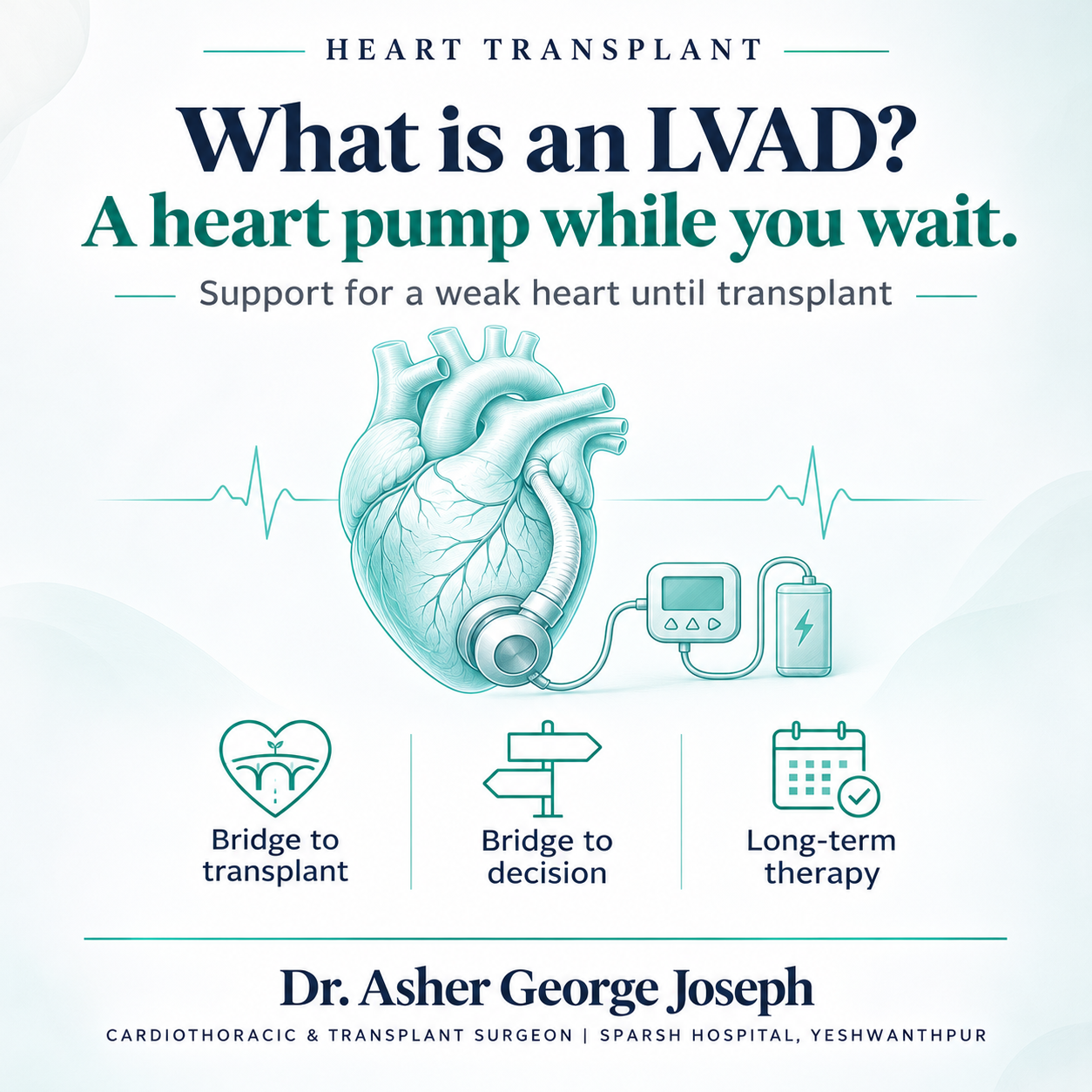
- Other options: if you are not ready for a transplant yet, we discuss alternatives, such as an LVAD (heart pump) for a weak heart, or ECMO support in an emergency.
- Tests if needed: blood tests, heart and lung scans, and assessments of other organs to check fitness for surgery.
- Family counselling: we explain the waiting list, the surgery, recovery and long-term care, so the whole family understands the journey.
Who may not be suitable for a transplant?
Not every patient is eligible. Active cancer, uncontrolled infection, severe damage to other organs, or ongoing smoking or alcohol use can make a transplant unsafe. Even then, an evaluation helps: some of these problems can be treated, and you may become eligible later.
What families can do
- Keep all medical reports and scans in one file.
- Note down how symptoms have changed over the past months.
- Write down your questions before the visit.
- Come together with the family members who will support the patient.
Frequently Asked Questions
Do I need a referral to see a transplant surgeon?
A referral from your cardiologist or pulmonologist is helpful, but you can also book a consultation directly for an opinion.
Does seeing a transplant surgeon mean I need surgery right away?
No. Many patients are evaluated early, monitored, and only listed when the time is right.
Is there an age limit for a transplant?
There is no single age cut-off. Overall health and fitness matter more than age alone.
Can I get a second opinion?
Yes. A transplant decision is a big one, and a second opinion is always welcome.
The key message
Earlier is better. Seeing a transplant surgeon early keeps more doors open and gives you the best chance of a good result.
Have questions about a heart or lung transplant? Book a consultation with Dr Asher George Joseph, Cardiothoracic & Transplant Surgeon at SPARSH Hospital, Yeshwanthpur, Bengaluru.