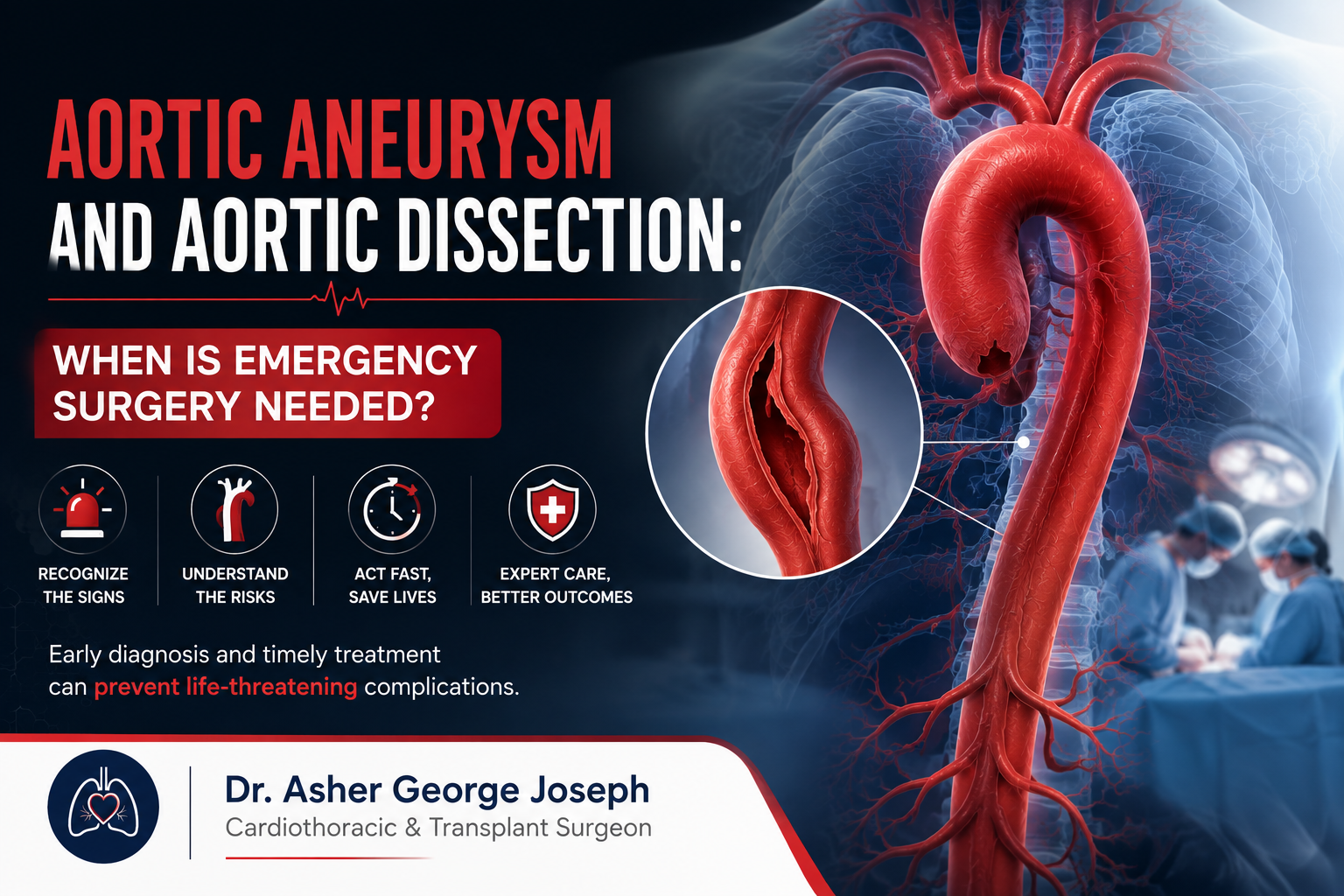
An aortic aneurysm can develop quietly for years without causing symptoms. An aortic dissection, however, can appear suddenly and become life-threatening within minutes.
Because both conditions involve the aorta—the body’s largest artery—they require careful and sometimes urgent specialist evaluation.
One of the most important questions patients and families ask is:
“Does every aortic aneurysm need surgery, and when does an aortic dissection become an emergency?”
The answer depends on the location of the disease, size of the aorta, rate of enlargement, symptoms, involvement of other arteries and whether the aortic wall has torn.
What Is the Aorta?
The aorta is the main artery carrying oxygen-rich blood from the heart to the rest of the body.
It begins at the heart and travels through the chest and abdomen.
Major sections include:
- Aortic root
- Ascending aorta
- Aortic arch
- Descending thoracic aorta
- Abdominal aorta
Problems affecting the aortic root and ascending aorta are particularly important because they are very close to the heart, aortic valve and arteries supplying the brain.
What Is an Aortic Aneurysm?
An aortic aneurysm is an abnormal enlargement or ballooning of part of the aorta.
As the aortic wall stretches, it can gradually become weaker.
A small aneurysm may remain stable for years. But as an aneurysm becomes larger, the risk of complications such as:
- Aortic dissection
- Rupture
- Aortic valve leakage
- Compression of nearby structures
can increase.
This is why regular monitoring is important even when a patient feels completely well.
What Is an Aortic Dissection?
An aortic dissection occurs when a tear develops in the inner layer of the aortic wall.
Blood then enters between the layers of the artery and creates a false channel within the wall.
This can interfere with blood flow to important organs including the:
- Brain
- Heart
- Kidneys
- Intestines
- Spinal cord
- Arms and legs
If the weakened aorta ruptures, severe internal bleeding can occur.
An aortic dissection is therefore considered a medical emergency.
Aortic Aneurysm vs Aortic Dissection
Although related, they are not the same condition.
An aneurysm is primarily enlargement of the artery.
A dissection involves a tear within the aortic wall.
A patient may have an aneurysm without a dissection, while some dissections can occur even when the aorta was not previously known to be severely enlarged.
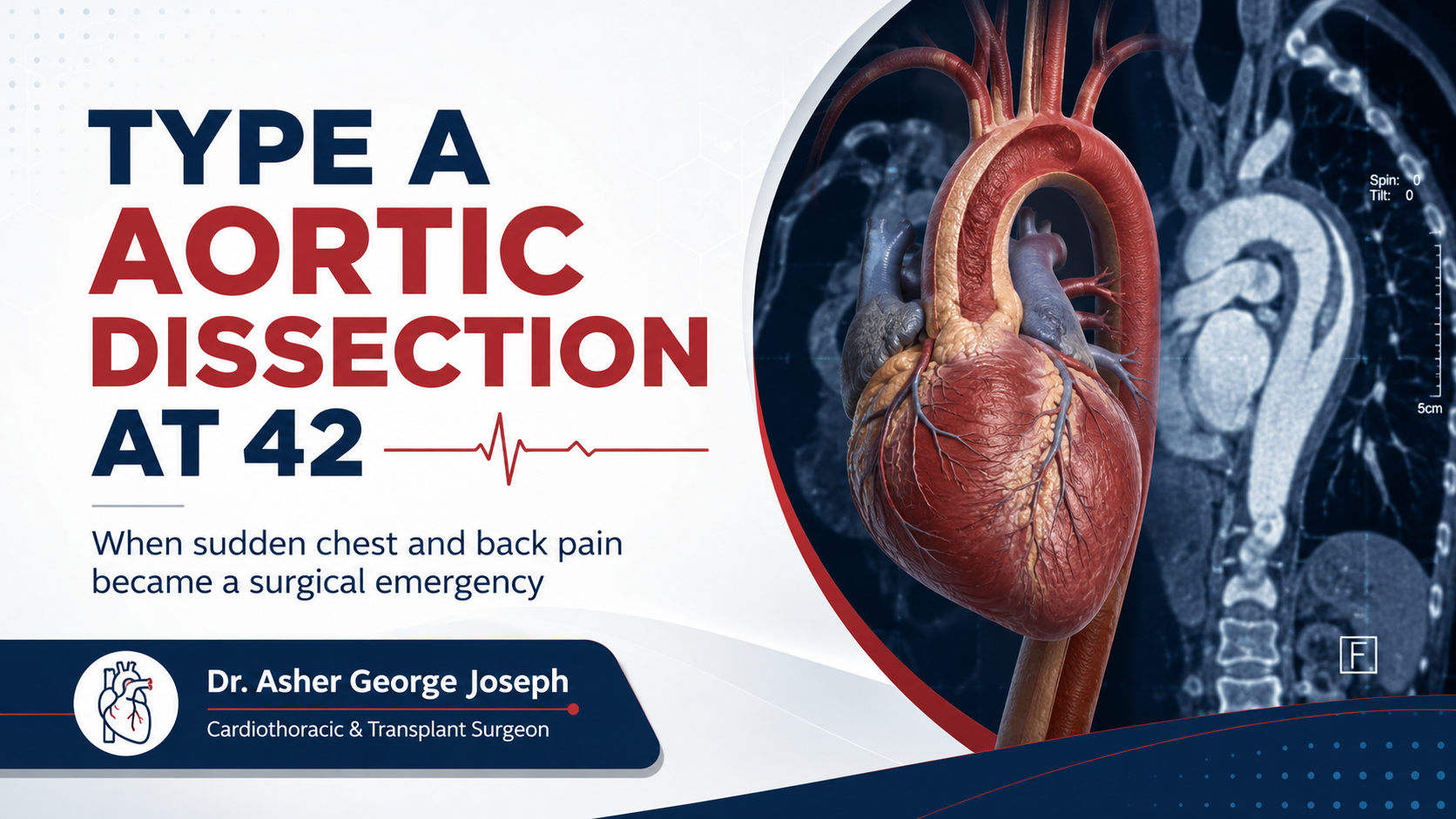
What Is a Type A Aortic Dissection?
Doctors often classify aortic dissections according to whether the ascending aorta is involved.
A Stanford Type A dissection involves the ascending aorta—the portion closest to the heart.
This condition is usually considered a surgical emergency.
Without treatment, complications can develop rapidly.
These can include:
- Rupture of the aorta
- Internal bleeding around the heart
- Severe aortic valve leakage
- Heart attack
- Stroke
- Loss of blood flow to major organs
Emergency surgery is usually performed to remove or reinforce the damaged section of the aorta and restore safe blood flow.
What Is a Type B Aortic Dissection?
A Stanford Type B dissection begins beyond the major branches supplying the arms and brain and does not involve the ascending aorta.
Not every Type B dissection requires immediate open surgery.
If the condition is uncomplicated, treatment may initially involve:
- Strict blood-pressure control
- Heart-rate control
- Pain management
- Intensive monitoring
- Repeated imaging
However, intervention may become necessary when complications develop.
When Does Type B Dissection Need Urgent Treatment?
Urgent treatment may be considered when there is:
- Aortic rupture or impending rupture
- Persistent or recurrent severe pain
- Uncontrolled blood pressure
- Rapid enlargement of the aorta
- Reduced blood supply to major organs
- Reduced blood flow to the legs
- Progressive aortic expansion
In suitable patients, treatment may sometimes be performed using thoracic endovascular aortic repair, or TEVAR, rather than conventional open surgery.
What Is TEVAR?
TEVAR stands for Thoracic Endovascular Aortic Repair.
Instead of replacing the diseased aorta through major open surgery, a covered stent graft is introduced through an artery, commonly from the groin, and positioned inside the diseased section of the thoracic aorta.
The stent graft redirects blood through a protected channel and reduces pressure on the damaged aortic wall.
TEVAR can be highly useful in selected patients with:
- Complicated Type B dissection
- Certain thoracic aortic aneurysms
- Traumatic aortic injury
- Selected other aortic conditions
However, not every patient’s anatomy is suitable for TEVAR.
Does Every Aortic Aneurysm Need Surgery?
No.
Many smaller aortic aneurysms can initially be managed with regular monitoring.
Doctors may recommend:
- Blood-pressure control
- Cholesterol management
- Smoking cessation
- Regular CT, MRI or echocardiographic imaging
- Avoidance of extreme blood-pressure surges
- Follow-up with an aortic or cardiac specialist
Surgery is generally considered when the predicted risk of rupture or dissection becomes greater than the risk of the operation.
When Is Surgery Considered for an Ascending Aortic Aneurysm?
One important factor is the diameter of the aorta.
For many patients with an ascending aortic aneurysm, surgery may be considered when the diameter approaches approximately 5.5 cm.
But this is not a fixed number for every patient.
Surgery may be recommended earlier when there are additional risk factors such as:
- Rapid enlargement of the aneurysm
- Symptoms related to the aneurysm
- Family history of aortic dissection
- Certain inherited connective-tissue disorders
- Bicuspid aortic valve with additional risk factors
- Aortic valve surgery already being planned
- Specific body-size considerations
- Abnormal aortic anatomy
Some patients may therefore require intervention at a smaller diameter.
Why Does the Rate of Aneurysm Growth Matter?
Aneurysm size is important, but how quickly it is growing can be equally important.
An aorta that shows rapid enlargement over serial scans may indicate increasing instability of the aortic wall.
This is why patients with known aneurysms should not skip follow-up scans even when they have no symptoms.
Doctors compare imaging over time rather than relying on one scan alone.
When Does an Aneurysm Become an Emergency?
A known aneurysm becomes particularly concerning if a patient suddenly develops symptoms suggesting:
- Dissection
- Rupture
- Compression of nearby organs
Emergency evaluation is required if someone with an aortic aneurysm develops sudden severe:
- Chest pain
- Back pain
- Fainting
- Breathlessness
- Weakness
- Stroke-like symptoms
A symptomatic or ruptured aneurysm may require immediate intervention irrespective of its previously measured size.
What Does Aortic Dissection Pain Feel Like?
Aortic dissection classically causes sudden, severe chest or back pain.
Patients may describe the pain as:
- Very intense
- Abrupt in onset
- Sharp
- Tearing
- Ripping
- Moving from the chest toward the back or abdomen
However, not every patient has a textbook description.
The important warning sign is new, sudden and unusually severe chest or back pain, particularly when accompanied by other symptoms.
Other Warning Signs of Aortic Dissection
Symptoms can include:
- Sudden severe chest or upper-back pain
- Fainting or collapse
- Sudden breathlessness
- Weakness or paralysis
- Difficulty speaking
- Sudden vision problems
- Severe abdominal pain
- Cold or painful leg
- Difference in pulse between arms
- Low blood pressure
- Sudden neurological symptoms
If these symptoms occur, emergency medical care should be sought immediately.
Can an Aortic Dissection Cause a Stroke?
Yes.
The aorta gives rise to arteries that supply blood to the brain.
If the dissection extends into these arteries or interferes with their blood flow, a patient can develop stroke-like symptoms.
This is one reason Type A dissection can become extremely dangerous very quickly.
Can an Aortic Dissection Cause a Heart Attack?
It can.
If the dissection interferes with the coronary arteries that supply the heart muscle, blood flow to the heart may be reduced.
The condition can sometimes mimic a conventional heart attack.
Correct diagnosis is essential because the treatment strategy can be very different.
Can a Dissection Damage the Aortic Valve?
Yes.
Because the aortic valve lies very close to the ascending aorta, a Type A dissection may affect the valve and cause severe aortic regurgitation.
This means blood leaks backward through the valve instead of moving efficiently forward.
During emergency aortic surgery, the surgeon may need to assess whether the aortic valve can be preserved or whether additional valve surgery is required.
What Happens During Emergency Surgery for Type A Dissection?
The exact operation depends on the location and extent of the tear.
Surgery may involve:
- Removing the damaged ascending aorta
- Replacing it with an artificial vascular graft
- Repairing or replacing the aortic root
- Repairing or replacing the aortic valve when necessary
- Treating part of the aortic arch when involved
- Restoring blood flow to affected vessels
These operations can be highly complex and require an experienced cardiac and aortic surgical team.
Can the Patient’s Own Aortic Valve Be Preserved?
In selected patients, yes.
If the valve itself remains structurally suitable, surgeons may sometimes perform a valve-sparing aortic root procedure.
This allows replacement of the diseased aortic root while preserving the patient’s natural aortic valve.
Whether this is possible depends on:
- Valve anatomy
- Extent of dissection
- Condition of the valve leaflets
- Aortic root anatomy
- Emergency circumstances
In unstable emergencies, the safest and most durable repair takes priority.
Who Is More Likely to Develop an Aortic Aneurysm or Dissection?
Risk can be higher in people with:
- Long-standing high blood pressure
- Bicuspid aortic valve
- Family history of aortic aneurysm or dissection
- Certain inherited connective-tissue disorders
- Smoking history
- Increasing age
- Existing aortic enlargement
- Previous aortic disease
Some dissections, however, occur in patients who were not previously known to have an aortic problem.
Why Is Blood-Pressure Control So Important?
High blood pressure places additional stress on the aortic wall.
In patients with known aortic disease, controlling blood pressure can help reduce this stress.
During an acute dissection, doctors often rapidly control both heart rate and blood pressure to reduce the force acting on the damaged aorta.
This treatment may begin immediately while the surgical or endovascular team prepares the next step.
How Is an Aortic Aneurysm Diagnosed?
Depending on the location, investigations may include:
- Echocardiography
- CT angiography
- MRI
- Transoesophageal echocardiography
CT angiography is particularly valuable in emergency situations because it can rapidly show the location and extent of an aortic dissection.
How Often Should an Aortic Aneurysm Be Monitored?
There is no single scanning interval for everyone.
Follow-up depends on:
- Aortic size
- Location
- Rate of growth
- Underlying cause
- Family history
- Valve disease
- Previous surgery
Some patients may require imaging within months, while patients with stable smaller aneurysms may be monitored at longer intervals.
The schedule should be individualized by the treating team.
Planned Surgery Is Very Different From Emergency Surgery
One of the major reasons doctors monitor aortic aneurysms carefully is to identify when elective surgery becomes appropriate before a rupture or dissection occurs.
Planned surgery allows time to:
- Assess coronary arteries
- Evaluate the aortic valve
- Review CT anatomy
- Assess kidney and lung function
- Plan the surgical technique
- Discuss risks and recovery
Emergency dissection surgery does not always allow this preparation time.
This is why appropriate surveillance of a known aneurysm is so important.
Frequently Asked Questions
Is every aortic aneurysm dangerous?
Not every aneurysm requires immediate surgery, but every diagnosed aneurysm deserves appropriate follow-up because enlargement can increase future risk.
At what size does an aortic aneurysm need surgery?
For many ascending aortic aneurysms, surgery is considered around 5.5 cm, but intervention may be recommended earlier depending on the patient’s anatomy, genetics, growth rate, symptoms and other risk factors.
Is a Type A aortic dissection always an emergency?
In most cases, yes. Because the ascending aorta is involved, urgent surgical evaluation is generally required.
Does every Type B dissection require surgery?
No. Uncomplicated Type B dissections may initially be treated medically. Complicated dissections may require TEVAR or surgery.
Can an aneurysm rupture without warning?
Yes. Some aneurysms produce no symptoms until a serious complication occurs, which is why surveillance is important.
Can aortic aneurysm surgery be planned before it becomes an emergency?
Yes. Elective surgery may be recommended when an aneurysm reaches a size or risk profile where intervention is considered safer than continued observation.
Is TEVAR the same as open-heart surgery?
No. TEVAR is an endovascular procedure performed through an artery. It is useful for selected parts of the thoracic aorta but is not suitable for every type of aneurysm or dissection.
Can aortic dissection happen in younger people?
Yes, particularly in patients with inherited aortic conditions, bicuspid aortic valves or certain connective-tissue disorders.
The Most Important Message
Aortic disease is unusual because a patient may feel completely normal while an aneurysm is slowly enlarging.
The goal is therefore to identify high-risk disease before it becomes an emergency.
For a known aneurysm, regular imaging and specialist follow-up can help determine the safest time for intervention.
But when sudden severe chest or back pain, collapse, breathlessness or neurological symptoms occur, particularly in someone with known aortic disease, urgent emergency evaluation is essential.
In aortic dissection, especially Type A dissection involving the ascending aorta, every minute can matter.
Dr. Asher George Joseph
Cardiothoracic & Transplant Surgeon
Advanced surgical care for complex heart and aortic conditions, including coronary bypass surgery, heart valve surgery, aortic surgery, advanced heart failure and transplantation.
Medical Disclaimer: This article is intended for general patient education and does not replace individual medical advice. Aortic aneurysms and dissections vary considerably between patients. Treatment decisions should be made after specialist assessment and appropriate imaging. Sudden severe chest or back pain, fainting, breathlessness or stroke-like symptoms require immediate emergency medical attention.