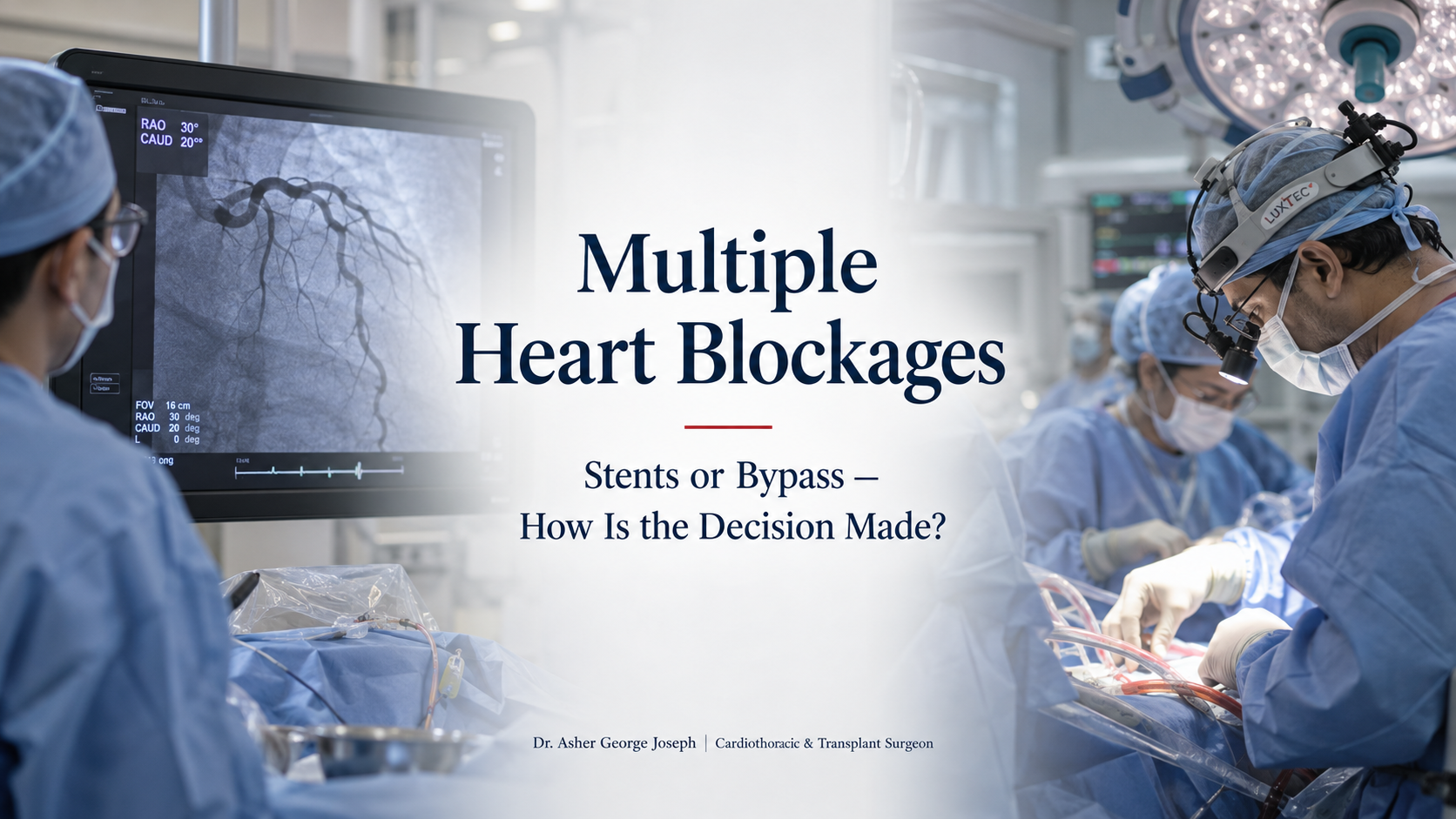
Hearing that you have multiple heart blockages can be overwhelming.
For many patients, the next question comes immediately:
“Do I need stents, or should I undergo bypass surgery?”
There is no single answer for everyone.
Two patients can both have “three blocked arteries” and still need completely different treatments because the decision depends on where the blockages are, how complex they are, how much heart muscle is at risk, whether diabetes is present, how well the heart is pumping, and the patient’s overall health.
The goal is not simply to open a blockage.
The real goal is to choose the treatment that offers the safest, most complete, and most durable restoration of blood flow for that particular patient.
First, What Does “Multiple Heart Blockages” Actually Mean?
The heart receives blood through the coronary arteries.
When more than one major coronary artery has significant narrowing, doctors may call it multivessel coronary artery disease.
For example, disease may involve:
- The left anterior descending artery (LAD)
- The right coronary artery
- The left circumflex artery
If all three major coronary territories are affected, it may be described as three-vessel disease.
But the number of blocked arteries is only part of the story.
Doctors also look at:
- How severe each blockage is
- Where the blockage is located
- Whether the disease is short and focal or long and diffuse
- Whether the artery is heavily calcified
- Whether there are complete blockages
- Whether important branching points are involved
This is why treatment cannot be decided by simply counting blockages.
What Is a Stent?
A stent is a small mesh tube placed inside a narrowed coronary artery during angioplasty.
A catheter is passed through an artery, usually from the wrist or groin, to reach the narrowed vessel.
The blockage is opened with a balloon, and a stent is placed to help keep the artery open.
Advantages of stenting may include:
- No open-heart surgery
- Shorter hospital stay
- Faster initial recovery
- Useful for selected focal blockages
- Suitable in many emergency heart-attack situations
Modern PCI has become extremely advanced, and many complex lesions can now be treated with sophisticated techniques.
But just because a blockage can be treated with a stent does not always mean stenting is the best long-term strategy.
What Is Bypass Surgery?
Coronary artery bypass grafting, or CABG, creates a new route for blood to travel around blocked coronary arteries.
Surgeons use healthy blood vessels from the:
- Chest
- Arm
- Leg
to create bypass grafts.
Instead of treating every individual narrowing, CABG can route blood beyond a long segment of diseased artery.
This is particularly important when disease is extensive.
So How Do Doctors Decide?
The decision usually comes down to a combination of anatomy, risk, and long-term benefit.
1. How Many Major Arteries Are Involved?
A single short blockage is very different from disease affecting all three major coronary arteries.
When several vessels contain significant disease, especially when the anatomy is complex, bypass surgery may offer more complete treatment.
However, multivessel disease does not automatically mean CABG.
Some patients with two or even three involved vessels can still be excellent candidates for stenting.
2. Is the Left Main Coronary Artery Involved?
The left main coronary artery supplies blood to a large portion of the heart.
Significant disease in this vessel is taken very seriously.
In selected patients, left main disease can be treated with PCI.
But when left main disease is complex or occurs together with extensive multivessel disease, bypass surgery may be preferred.
This is one of the situations where discussion between an interventional cardiologist and a cardiac surgeon can be particularly valuable.
3. Are the Blockages Simple or Complex?
Not every 80% blockage is the same.
Doctors assess whether the disease involves:
- Long segments
- Severe calcification
- Multiple lesions
- Bifurcations
- Chronic total occlusions
- Small vessels
- Diffuse disease
A short, well-defined blockage may be straightforward to stent.
A long, heavily calcified vessel with several narrowings may require multiple overlapping stents.
In that situation, bypass surgery may provide a more durable alternative.
A Very Important Question: How Many Stents Would Be Needed?
Patients often ask:
“Can’t you just put more stents?”
Sometimes that is entirely reasonable.
But if treatment would require:
- Many stents
- Very long stented segments
- Multiple complex procedures
- Repeated interventions in several arteries
the team may consider whether bypass surgery offers a more complete solution.
The decision is not about avoiding stents.
It is about avoiding an approach that may not provide the best long-term result.
Diabetes Can Change the Decision
Patients with diabetes often develop a different pattern of coronary artery disease.
The disease may be:
- More widespread
- More diffuse
- Present in several vessels
- More likely to involve smaller arteries
Because of this pattern, bypass surgery is frequently considered in patients with diabetes and complex multivessel disease.
This does not mean every diabetic patient requires surgery.
But diabetes is an important factor in the decision.
What If the Heart Pumping Function Is Low?
Some patients with multiple blockages also have reduced heart function.
For example, the ejection fraction may be 25% or 30%.
This does not automatically mean surgery is impossible.
Doctors assess:
- Whether the heart muscle is still viable
- Whether poor blood flow is contributing to weak heart function
- Overall surgical risk
- Kidney function
- Lung function
- Previous heart attacks
- Frailty and general condition
In carefully selected patients, restoring blood flow with bypass surgery may still be considered even when heart function is significantly reduced.
What If I Already Have Stents?
Previous stents do not automatically rule out bypass surgery.
Some patients undergo PCI first and later develop:
- New blockages
- Progression of coronary disease
- Restenosis
- Recurrent symptoms
- Disease that is no longer suitable for further stenting
In such cases, surgeons can assess whether bypass grafts can be placed beyond the previously treated segments.
Is Bypass Better Because It Lasts Longer?
Sometimes, but not always.
Durability depends on many factors, including:
- Type of bypass graft used
- Quality of the target artery
- Diabetes
- Smoking
- Cholesterol control
- Blood pressure
- Medication adherence
The left internal mammary artery to the LAD is particularly valued for its long-term performance.
This is one reason CABG can be an attractive option in selected patients with extensive coronary disease.
Is Stenting Always Safer Because It Is Less Invasive?
Not necessarily.
PCI usually has a shorter initial recovery and avoids major surgery.
But treatment decisions should not be based only on which procedure appears easier in the short term.
Doctors also consider:
- Risk of repeat procedures
- Risk of recurrent symptoms
- Ability to achieve complete revascularization
- Long-term survival
- Overall quality of life
- Surgical risk
The least invasive treatment is not automatically the best treatment for every patient.
Why the Heart Team Approach Matters
Complex coronary disease is often best evaluated using a Heart Team approach.
This may include:
- Interventional cardiologists
- Cardiothoracic surgeons
- Imaging specialists
- Heart failure specialists
- Anaesthesiologists
- Other specialists as required
The team reviews the angiogram, the patient’s condition, and all available options.
The goal is not:
Stent vs surgery as competitors.
The goal is:
Which treatment gives this patient the best overall result?
A Simple Example
Imagine two patients.
Patient A
Has three blockages, but each is short, accessible, and relatively straightforward.
PCI may be a very reasonable option.
Patient B
Also has three blocked vessels, but the disease is:
- Long
- Heavily calcified
- Diffuse
- Involves the LAD
- Includes important branch points
- Occurs in a patient with diabetes
Bypass surgery may provide a more complete and durable solution.
Both patients have “three blockages.”
But their treatment can be very different.
What Questions Should Patients Ask?
If you have multiple coronary blockages, useful questions include:
- How many major vessels are affected?
- Is the left main artery involved?
- Is the disease focal or diffuse?
- How many stents would be required?
- Is the disease heavily calcified?
- Do I have diabetes?
- How well is my heart pumping?
- Can complete treatment be achieved with PCI?
- Would bypass offer better long-term durability?
- Has my case been reviewed by both a cardiologist and cardiac surgeon?
These questions help patients understand the reasoning behind the recommendation.
Does Every 70% Blockage Need Treatment?
No.
Treatment depends on more than the percentage seen on angiography.
Doctors also consider:
- Symptoms
- Blood-flow significance
- Location
- Functional testing
- Overall coronary anatomy
Some blockages may be treated medically.
Others may require PCI or surgery.
Can Medicines Replace Stents or Bypass?
For some patients, yes.
Not every patient with coronary disease needs a procedure immediately.
Medical therapy may include:
- Antiplatelet medicines
- Cholesterol-lowering treatment
- Blood-pressure control
- Diabetes management
- Lifestyle modification
But when disease is severe, symptoms continue, or a large amount of heart muscle is at risk, revascularization may be recommended.
When Is Bypass More Likely to Be Considered?
CABG may be strongly considered when there is:
- Complex three-vessel disease
- Significant left main disease
- Diabetes with extensive multivessel disease
- Long or diffuse blockages
- Multiple calcified lesions
- Disease not suitable for complete PCI
- Reduced heart function with suitable anatomy
- Need for another cardiac surgery at the same time
Every case still needs individual assessment.
When Might Stents Be Preferred?
PCI may be preferred when:
- Disease is less complex
- Blockages are short and focal
- Surgery carries high risk
- Faster recovery is important
- Only one or two major lesions require treatment
- Anatomy is highly suitable for PCI
- Urgent treatment is needed during a heart attack
Again, there is no one-size-fits-all answer.
Frequently Asked Questions
I have three blocked arteries. Does that mean I definitely need bypass?
No. Three-vessel disease is important, but the decision depends on the complexity and location of the disease, diabetes, heart function, and surgical risk.
Can five or six stents be placed?
Technically, multiple stents can sometimes be placed. But doctors also consider whether that strategy provides the best long-term result compared with CABG.
Is bypass possible after previous angioplasty?
Yes. Many patients undergo CABG after previous stent procedures when clinically appropriate.
Is bypass riskier than stenting?
CABG is a major operation and carries different risks than PCI. But long-term benefits may outweigh the initial surgical risk in selected patients.
Which treatment has faster recovery?
Stenting usually has faster initial recovery.
Which lasts longer?
That depends on the patient’s anatomy, type of treatment, risk factors, and follow-up. In selected complex multivessel disease, CABG may provide greater long-term durability.
The Most Important Message
If you have multiple heart blockages, the decision is not simply:
“How many blockages are there?”
It is:
“What is the pattern of disease, and which treatment gives the safest and most durable result for this particular heart?”
For some patients, stents are exactly the right treatment.
For others, bypass surgery offers a more complete solution.
And for some, optimal medical therapy may be appropriate.
That is why complex coronary disease should be evaluated with the complete clinical picture in mind—not just the angiogram report.
Dr. Asher George Joseph
Cardiothoracic & Transplant Surgeon
Areas of Expertise:
Coronary Bypass Surgery | Complex Cardiac Surgery | Aortic Surgery | Advanced Heart Failure | Heart & Lung Transplantation
Patient Education Focus: Helping patients understand their treatment options and make informed decisions with their Heart Team.
Medical disclaimer: This article is intended for general education and does not replace individual medical advice. Treatment decisions for coronary artery disease should be based on symptoms, coronary anatomy, heart function, associated medical conditions, and specialist evaluation.