When an angiogram shows blockages in two or three major coronary arteries, one of the most important questions patients and families ask is:
“Can all these blockages be treated with stents, or is bypass surgery a better option?”
There is no single answer for every patient. Both coronary artery bypass grafting (CABG) and angioplasty with stent placement (PCI) can restore blood flow to the heart, but they work differently and may offer different long-term benefits depending on the number, location, complexity, and extent of the blockages.
For patients with multiple or complex coronary artery blockages, bypass surgery may sometimes provide a more complete and durable form of revascularization.
What Does “Multiple Blocked Arteries” Mean?
The heart receives its blood supply through the coronary arteries.
When significant narrowing develops in more than one major coronary artery, it is commonly called multivessel coronary artery disease.
For example, a patient may have significant disease involving:
- The left anterior descending artery (LAD)
- The left circumflex artery
- The right coronary artery
When all three major coronary territories are affected, it may be described as three-vessel coronary artery disease.
The decision is not based only on whether a blockage is “70%” or “90%.” Doctors also evaluate where the blockage is located, how long it is, whether it is calcified, whether vessels are diffusely diseased, and how much heart muscle is at risk.
Stents vs Bypass Surgery: What Is the Difference?
Coronary Angioplasty and Stenting
During angioplasty, a catheter is passed through an artery, usually from the wrist or groin, to reach the blocked coronary artery.
A balloon is used to open the narrowing, and a stent is placed to help keep the artery open.
PCI is less invasive than open-heart surgery and generally involves a shorter hospital stay and faster initial recovery.
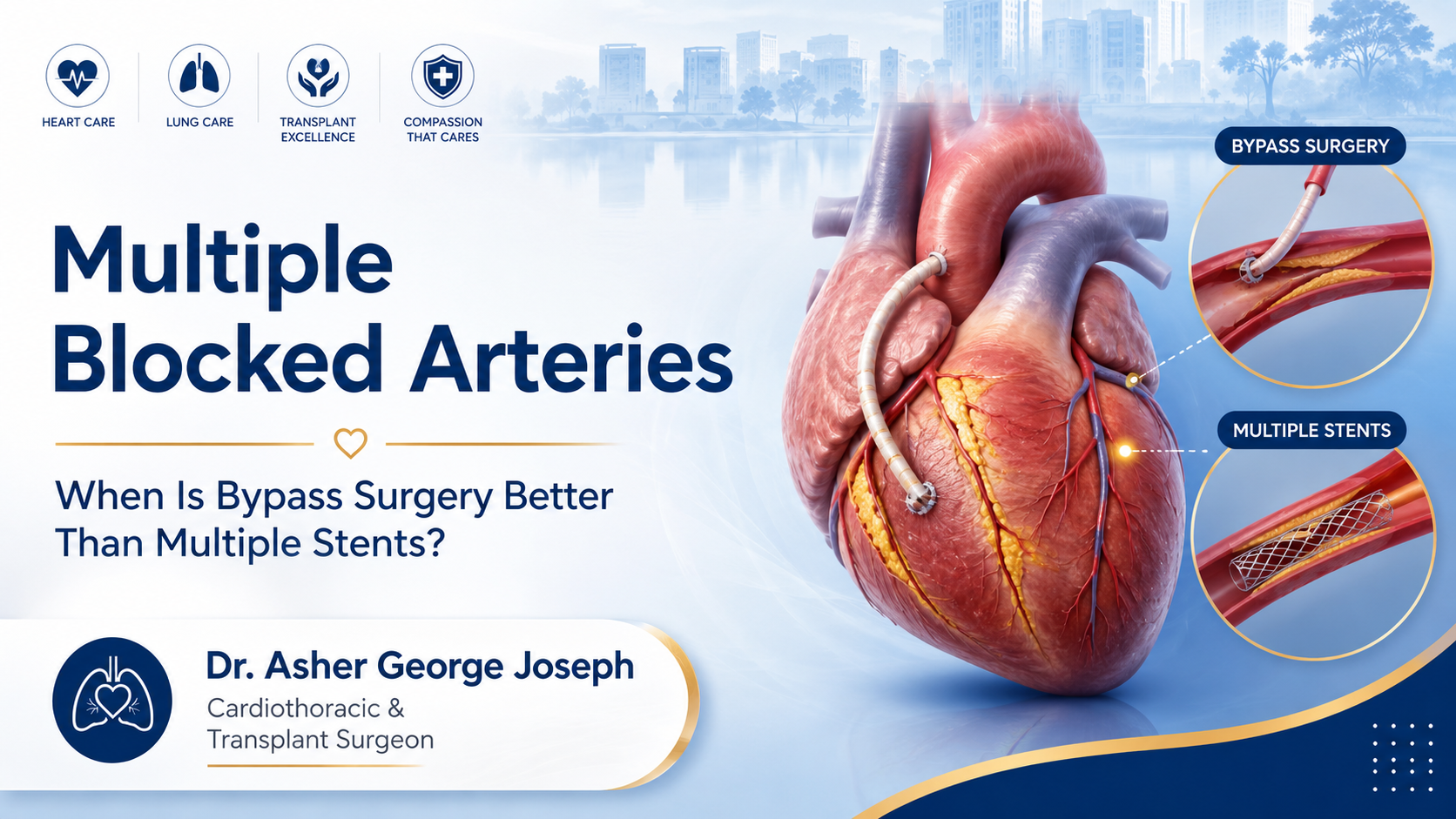
However, when several arteries contain multiple long or complex blockages, the patient may require several stents.
Coronary Artery Bypass Grafting
CABG creates a new route for blood to travel around the blocked portions of the coronary arteries.
Healthy blood vessels from the:
- Chest
- Arm
- Leg
may be used as bypass grafts.
One important advantage is that the bypass can often deliver blood beyond a long segment of diseased artery, instead of treating each individual narrowing separately.
This can be particularly valuable when coronary disease is widespread.
When May Bypass Surgery Be Better Than Multiple Stents?
Several factors can favor CABG.
1. Three-Vessel Coronary Artery Disease
When all three major coronary arteries are significantly diseased, bypass surgery may provide more complete revascularization in selected patients.
Instead of inserting multiple stents into several areas, bypass grafts can provide alternative blood-flow pathways to multiple regions of the heart.
For patients with anatomically complex three-vessel disease, CABG may also offer greater long-term durability.
2. Diabetes With Multiple Coronary Blockages
Diabetes can cause coronary artery disease to be more extensive and diffuse.
Instead of one short blockage, diabetic patients may have disease affecting longer portions of several coronary arteries.
In appropriately selected patients with diabetes and multivessel coronary disease, particularly when the LAD is involved, CABG is frequently considered because it may provide important long-term advantages compared with treating numerous lesions individually with stents.
The decision still depends on the patient’s overall health, anatomy and surgical risk.
3. Complex Left Main Coronary Artery Disease
The left main coronary artery supplies blood to a very large portion of the heart.
Significant left main disease therefore requires careful assessment.
While some left main blockages can be treated successfully with PCI, bypass surgery may be preferred when there is:
- Complex left main disease
- Additional multivessel disease
- Extensive branching-point disease
- Diffuse coronary disease
- Anatomy that would require several complicated stenting procedures
A Heart Team assessment is particularly important in these patients.
4. Long, Diffuse Blockages
Stents work very well for many focal coronary narrowings.
But if disease extends across long sections of an artery, several overlapping stents may sometimes be necessary.
CABG can potentially bypass the entire diseased segment and connect blood flow farther downstream.
This is why diffuse coronary artery disease can sometimes be more suitable for surgery than repeated or extensive stenting.
5. Several Complex Blockages in Different Arteries
Some patients have a combination of:
- Long lesions
- Severe calcium
- Bifurcation lesions
- Chronic total occlusions
- Small diseased vessels
- Multiple lesions within the same artery
PCI may technically be possible, but treatment can become increasingly complex as the number of lesions rises.
The goal is not simply to ask:
“Can we put stents?”
The more useful question is:
“Which strategy gives this patient the safest and most durable overall result?”
6. When Complete Revascularization With Stents Is Difficult
The aim of coronary treatment is to restore adequate blood flow to the areas of heart muscle that need it.
Sometimes stenting all significant areas is difficult because of coronary anatomy.
CABG may allow surgeons to bypass several important diseased vessels during one operation, achieving more complete revascularization in selected patients.
7. Blockages Involving the LAD
The LAD is one of the heart’s most important arteries.
A vessel from inside the chest called the left internal mammary artery (LIMA) is commonly used during CABG to bypass significant LAD disease.
The LIMA-to-LAD graft is valued for its excellent long-term performance and is one of the reasons bypass surgery can be an attractive option in appropriate patients with extensive coronary disease.
8. Reduced Heart Pumping Function
Patients with severe coronary disease may also develop reduced left ventricular function or heart failure because areas of heart muscle are receiving inadequate blood supply.
In selected patients with extensive coronary disease and reduced heart function, surgical revascularization may offer important benefits.
However, these cases require careful assessment because reduced heart function can also increase operative risk.
The team may evaluate:
- Heart pumping function
- Viability of heart muscle
- Kidney function
- Lung function
- Previous heart attacks
- Other medical conditions
before recommending treatment.
Does Having Many Blockages Automatically Mean Bypass Surgery?
No.
The number of blockages alone does not determine treatment.
Two patients can both have “three blocked arteries” and still require completely different treatment strategies.
Doctors consider the entire coronary anatomy.
For example, one patient may have three short, straightforward narrowings that can be treated effectively with PCI.
Another may have the same three arteries affected by long, heavily calcified, branching or completely blocked lesions. CABG may be more appropriate in that situation.
When Might Multiple Stents Be Preferred?
Bypass surgery is not always the better option.
PCI may be preferred when:
- Coronary disease is less complex
- Blockages are short and suitable for stenting
- Only one or two important areas require treatment
- Surgery carries unusually high risk
- The patient has significant medical conditions affecting recovery
- Rapid revascularization is required in an emergency
- Previous surgeries make repeat surgery particularly complex
- Coronary anatomy is favorable for PCI
Modern PCI techniques, intravascular imaging and advanced stents have significantly expanded the range of disease that can be treated through catheter-based procedures.
Multiple Stents vs CABG: A Simple Comparison
| Factor | Multiple Stents | Bypass Surgery |
|---|---|---|
| Procedure | Catheter-based | Surgical |
| Chest incision | Usually no | Usually required, although minimally invasive options exist for selected cases |
| Initial recovery | Generally faster | Generally longer |
| Best suited for | Selected focal or less complex disease | Often considered for complex or extensive multivessel disease |
| Multiple lesions | May require several stents | Several vessels can often be bypassed |
| Diffuse disease | Can be challenging | May be more suitable in selected patients |
| Diabetes + complex multivessel disease | Individualized | Frequently considered |
| Repeat procedures | May be necessary in some patients | Often selected for durability in suitable anatomy |
This table is only a general comparison. It cannot determine the right treatment for an individual patient.
Why the Heart Team Approach Matters
One of the most important developments in modern coronary care is the Heart Team approach.
For complex multivessel coronary disease, the case may be reviewed by specialists including:
- Interventional cardiologists
- Cardiac surgeons
- Cardiac imaging specialists
- Heart failure specialists
- Anaesthesiologists
- Other specialists when necessary
The objective is not to promote surgery over angioplasty—or angioplasty over surgery.
The objective is to determine which option provides the best balance of safety, completeness of treatment, recovery, durability and long-term outcome for that particular patient.
What Does the Surgeon Assess Before CABG?
Before recommending bypass surgery, several factors are evaluated.
These can include:
Coronary anatomy: Which vessels are blocked, and where?
Severity of disease: Are the blockages focal or diffuse?
Heart function: How well is the heart pumping?
Previous heart procedures: Has the patient already undergone stenting or bypass surgery?
Age and frailty: Can the patient tolerate major surgery and rehabilitation?
Diabetes: Is there extensive diabetic coronary disease?
Kidney function: Kidney impairment may influence treatment planning.
Lung disease: Severe lung disease can affect surgical risk.
Other valve or aortic disease: Occasionally a patient requires bypass surgery together with another cardiac procedure.
Can CABG Be Performed After Previous Stents?
Yes.
Having coronary stents does not automatically prevent a patient from undergoing bypass surgery later.
Some patients initially undergo PCI and develop:
- New blockages elsewhere
- Progression of coronary disease
- Recurrent symptoms
- Disease unsuitable for further stenting
If necessary, surgeons can evaluate whether bypass grafts can be placed beyond previously stented or diseased segments.
Can Bypass Surgery and Valve Surgery Be Done Together?
In some patients, yes.
A patient may have both severe coronary artery disease and significant valve disease.
Depending on the patient’s condition, surgeons may perform procedures such as:
CABG + aortic valve replacement
or
CABG + mitral valve repair/replacement
during the same operation.
This requires detailed preoperative planning because combined procedures can be more complex than isolated CABG.
Is Bypass Surgery Safe in Elderly or High-Risk Patients?
Age alone does not determine whether someone can undergo CABG.
Doctors assess the patient’s overall physiological condition rather than simply the number of years they have lived.
Important factors include:
- Frailty
- Kidney function
- Lung function
- Neurological health
- Heart function
- Previous operations
- Mobility
- Other medical illnesses
Some older patients remain excellent surgical candidates, while others may benefit more from a less invasive catheter-based strategy.
Symptoms of Significant Coronary Artery Disease
Patients with multiple coronary blockages may experience:
- Chest pressure or heaviness
- Chest pain during walking or exercise
- Shortness of breath
- Reduced exercise capacity
- Unusual tiredness
- Sweating
- Pain spreading to the shoulder, arm, jaw or back
However, some patients—particularly those with diabetes—may have significant coronary disease without classic chest pain.
When Should You Seek Emergency Medical Care?
Seek urgent medical assessment for symptoms such as:
- New or severe chest pressure
- Chest discomfort lasting several minutes
- Sudden breathlessness
- Cold sweating
- Fainting or near-fainting
- Chest discomfort associated with nausea
- Pain spreading to the jaw, arm, shoulder or back
These symptoms can indicate an acute coronary syndrome or heart attack and should not wait for a routine appointment.
Frequently Asked Questions
Is bypass always better for three-vessel disease?
No. CABG is often considered for complex three-vessel disease, but treatment depends on coronary anatomy, diabetes, age, surgical risk, heart function and other factors.
How many stents are too many?
There is no universal number. The decision depends more on how much coronary disease exists and how complex it is than simply counting stents.
Can five or six blockages be treated with stents?
Sometimes they can, but technical possibility does not automatically mean PCI is the best long-term strategy. Complex cases should be evaluated carefully.
Can bypass surgery treat several blockages at once?
Yes. Multiple bypass grafts can be created during one surgery to supply different regions of the heart.
Can a patient undergo bypass surgery after angioplasty?
Yes. Previous angioplasty or stenting generally does not rule out future CABG.
Which is safer: bypass surgery or stenting?
Both procedures have risks and benefits. PCI usually has a shorter initial recovery, while CABG may offer advantages for certain forms of extensive or complex disease. Individual risk assessment is essential.
How long does a bypass last?
Graft durability varies depending on the type of graft, the target artery, patient health and risk-factor control. Arterial grafts, particularly the internal mammary artery, are known for strong long-term durability.
Will bypass surgery cure coronary artery disease?
CABG improves blood flow but does not eliminate the underlying tendency to develop atherosclerosis. Long-term treatment still includes medicines and control of cholesterol, blood pressure, diabetes, weight, smoking and physical activity.
The Important Question Is Not “Stent or Surgery?” in Isolation
When several coronary arteries are blocked, patients understandably want the least invasive treatment possible.
But the treatment with the smallest incision is not automatically the treatment that offers the greatest long-term benefit.
Likewise, having multiple blockages does not automatically mean a patient needs bypass surgery.
The decision should answer a broader question:
Which treatment can restore blood flow safely, adequately and durably for this particular patient’s heart?
For complex multivessel coronary artery disease, evaluation by both an interventional cardiologist and a cardiac surgeon can help patients understand all reasonable options before making a decision.
Dr. Asher George Joseph
Cardiothoracic & Transplant Surgeon
Advanced evaluation and surgical management of complex cardiac disease, including coronary bypass surgery, heart valve surgery, advanced heart failure and transplantation.
Medical disclaimer: This article is for patient education and does not replace individual medical evaluation. The decision between PCI and CABG must be based on coronary anatomy, symptoms, heart function, associated illnesses and assessment by the treating Heart Team.