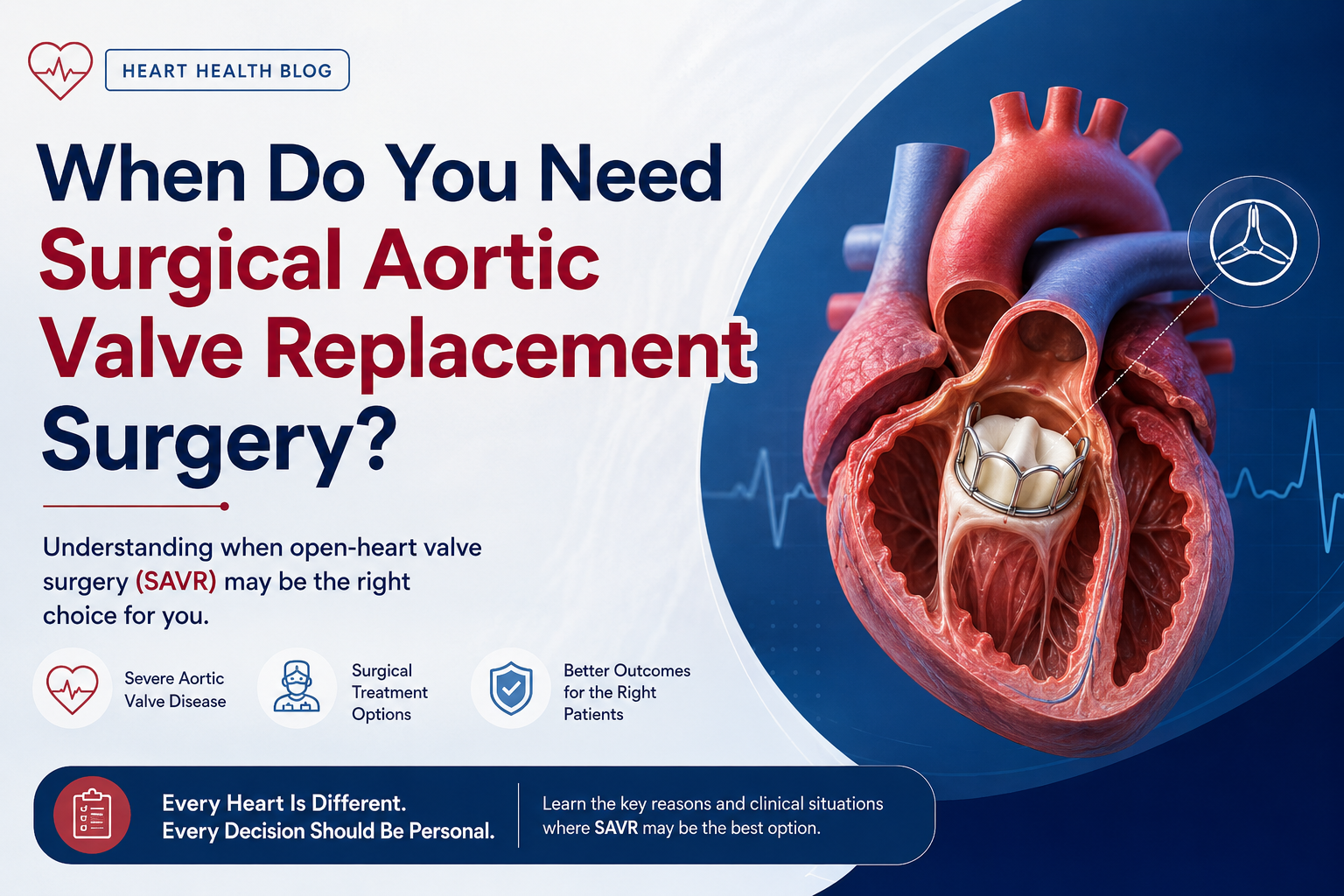
If you have been diagnosed with severe aortic valve disease, one of the first questions you may have is:
“Do I need open-heart surgery, or can I have TAVR?”
Transcatheter Aortic Valve Replacement, commonly called TAVR or TAVI, has transformed the treatment of aortic stenosis. It allows doctors to replace the valve through a catheter, usually without opening the chest.
Because it is less invasive, many patients understandably assume that TAVR must always be the better option.
But that is not necessarily true.
For some patients, Surgical Aortic Valve Replacement (SAVR) can still provide the most appropriate, durable and comprehensive treatment — particularly in younger patients, people with bicuspid valves, patients who need bypass surgery or aortic repair at the same time, and those who may benefit from a mechanical valve.
The real question therefore isn’t:
“Which procedure is newer?”
It is:
“Which treatment is safest and most appropriate for me over my lifetime?”
What Is Aortic Valve Disease?
The aortic valve sits between the heart’s main pumping chamber — the left ventricle — and the aorta, the large artery carrying blood to the body.
Normally, the valve opens fully when the heart pumps and closes tightly afterwards.
Two major problems can affect it.
Aortic Stenosis
The valve becomes narrowed and cannot open properly.
This makes the heart work harder to push blood through the valve.
Over time, severe stenosis can cause:
- Breathlessness
- Chest pain
- Fatigue
- Dizziness
- Fainting
- Reduced exercise capacity
- Heart failure
Aortic Regurgitation
The valve does not close properly, allowing blood to leak backwards into the heart.
Over time, this can cause enlargement and weakening of the left ventricle.
Both conditions may eventually require valve surgery.
What Is Surgical Aortic Valve Replacement?
Surgical Aortic Valve Replacement, or SAVR, is an operation in which a cardiac surgeon removes the diseased aortic valve and replaces it with a prosthetic valve.
The replacement valve may be either:
Mechanical Valve
Made from highly durable artificial materials.
Mechanical valves can last for decades but generally require lifelong anticoagulation with medicines such as warfarin.
Biological or Tissue Valve
Usually manufactured using treated animal tissue.
These valves generally do not require lifelong warfarin solely because of the valve, but they can gradually deteriorate over time.
Valve choice is especially important in younger patients because treatment needs to be planned over an entire lifetime.
When Does Aortic Stenosis Require Valve Replacement?
Not every patient with aortic stenosis needs surgery immediately.
Mild and moderate disease may often be monitored with regular echocardiograms and specialist review.
Valve replacement becomes particularly important when stenosis becomes severe and causes symptoms, or when severe disease begins affecting the heart’s pumping function. Current guidelines also recognize selected situations where intervention may be considered before obvious symptoms appear when testing suggests the heart is beginning to suffer.
The classic symptoms patients should not ignore are:
- Breathlessness while walking
- Chest discomfort or pressure
- Fainting or near-fainting
- Unexplained tiredness
- Reduced ability to exercise
- Swelling of the legs
- Increasing difficulty performing everyday activities
Once severe aortic stenosis becomes symptomatic, simply treating symptoms with medication does not correct the narrowed valve.
The valve itself needs to be addressed.
So When Is Surgical Aortic Valve Replacement the Better Choice?
This is where patient selection becomes extremely important.
TAVR and SAVR are not competing treatments where one is universally better.
They are two different ways of treating the same valve problem, and each has situations where it may offer an advantage.
Here are some of the most important reasons a Heart Team may recommend surgery.
1. You Are Younger and Have a Long Life Expectancy
Age alone never decides treatment, but it matters because the valve needs to function for the remainder of the patient’s life.
Current European guidance generally favors SAVR for low-surgical-risk patients younger than 70, whereas TAVI is generally favored in suitable patients aged 70 or older with tricuspid aortic stenosis. American guidance has historically used somewhat different age bands, which illustrates why age should be treated as one component of an individualized decision rather than a rigid rule.
Consider a healthy 48-year-old patient.
The question isn’t merely:
“Which procedure allows me to leave hospital faster?”
It is:
“What valve strategy gives me the best options over the next 30 or 40 years?”
A younger patient could potentially require multiple interventions during their lifetime if a tissue valve eventually degenerates.
That makes long-term planning especially important.
2. You May Benefit From a Mechanical Aortic Valve
This is one of the biggest differences between SAVR and TAVR.
TAVR valves are biological tissue valves.
If a young patient is suitable for and prefers a mechanical valve because of its durability, this requires surgical implantation.
Mechanical valves may be particularly attractive to some younger patients because they are designed for very long-term durability.
The trade-off is that patients generally need lifelong blood-thinning medication and regular anticoagulation monitoring.
The choice therefore depends on:
- Age
- Life expectancy
- Bleeding risk
- Ability to take anticoagulation reliably
- Lifestyle
- Pregnancy considerations
- Patient preference
There isn’t one valve that is best for everyone.
3. You Have a Bicuspid Aortic Valve
A normal aortic valve usually has three leaflets.
Some people are born with only two — known as a bicuspid aortic valve.
Bicuspid valves can become narrowed or leaky at a younger age and may also be associated with enlargement of the ascending aorta.
For appropriately selected older or higher-risk patients with suitable anatomy, TAVR may be considered.
However, surgery remains particularly important for many younger, low-risk patients with bicuspid valve disease, especially when there is substantial calcification or associated enlargement of the aorta.
Why?
Because surgery allows the surgeon to directly address both the valve and the aorta if necessary.
4. Your Ascending Aorta Is Enlarged
Sometimes the problem is not limited to the valve.
The aorta immediately above the valve may also become enlarged or develop an aneurysm.
This occurs particularly frequently in patients with bicuspid aortic valve disease.
TAVR replaces the valve but does not repair an enlarged ascending aorta.
During surgical treatment, however, the surgeon can replace the diseased valve and repair or replace the enlarged portion of the aorta during the same operation.
This can be an important reason to choose surgery.
5. You Also Need Coronary Artery Bypass Surgery
Some people with severe aortic stenosis also have significant coronary artery blockages.
If the coronary disease is complex enough to require Coronary Artery Bypass Grafting (CABG), surgery can address both problems during the same operation:
Aortic valve replacement + bypass surgery
This can offer a more comprehensive treatment strategy than dealing with each condition separately.
The ACC/AHA framework specifically identifies severe coronary artery disease requiring bypass grafting as one of the important factors that may favor SAVR.
6. Another Heart Valve Also Needs Surgery
Some patients have more than one valve problem.
For example:
Severe aortic stenosis + severe mitral valve disease
or
Aortic valve disease + significant tricuspid valve disease
If another valve also needs surgical repair or replacement, surgeons can potentially address multiple problems during the same operation.
In these situations, simply replacing the aortic valve through a catheter may leave the second major problem untreated.
7. You Have an Aortic Root Problem
The aortic root is the portion of the aorta immediately connected to the heart.
Certain patients have:
- Aortic root aneurysm
- Bicuspid valve-associated aortopathy
- Connective-tissue disorders
- Complex aortic root disease
These problems may require reconstruction or replacement of the aortic root in addition to treatment of the valve.
That requires surgery.
8. You Have Aortic Regurgitation Rather Than Calcific Aortic Stenosis
TAVR was developed primarily for aortic stenosis.
In pure severe aortic regurgitation, the valve may leak badly without having the heavy calcium that traditionally helps anchor a transcatheter valve.
Transcatheter technology for aortic regurgitation is developing, and selected patients who cannot undergo surgery may now have catheter-based options.
But for many operable patients with severe aortic regurgitation requiring intervention, surgery remains the established treatment.
9. You Have Active Infection of the Aortic Valve
Infective endocarditis is an infection involving the heart valve.
It can cause:
- Severe valve destruction
- Abscess formation
- Valve leakage
- Heart failure
- Infection spreading around the heart
- Emboli or stroke
In appropriate patients who need an operation, surgery allows the infected and damaged tissue to be removed and the affected structures reconstructed.
Simply inserting another valve through the damaged infected valve does not address the underlying infected tissue.
10. Your Anatomy Is Not Suitable for TAVR
Successful TAVR depends heavily on anatomy.
Before TAVR, detailed CT imaging is usually performed to evaluate:
- Aortic annulus size
- Valve calcification
- Coronary artery position
- Aortic root anatomy
- Femoral arteries
- Aorta
- Access route
Certain anatomical features can make TAVR difficult or increase the risk of complications.
Surgery may then provide a safer or more predictable approach.
11. You Have Several Heart Problems That Can Be Corrected at One Operation
This is where the difference between TAVR and SAVR becomes especially clear.
TAVR essentially focuses on replacing the aortic valve.
Heart surgery can potentially address several problems at once.
For example:
Aortic stenosis + coronary artery disease + ascending aortic aneurysm
could potentially require:
SAVR + CABG + ascending aortic repair
during the same operation.
Similarly, surgery may allow treatment of associated mitral disease, septal hypertrophy requiring myectomy, or other structural problems. Current guideline frameworks specifically identify several of these accompanying conditions as factors that can favor surgery.
But Isn’t TAVR Safer Because It Is Less Invasive?
Not necessarily.
Less invasive and safer are not always the same thing for every patient.
TAVR offers major advantages, particularly for appropriately selected older patients.
Potential benefits can include:
- No conventional sternotomy
- Shorter hospital stay in many patients
- Faster early recovery
- Less initial surgical trauma
But TAVR also has its own considerations, including:
- Pacemaker risk
- Paravalvular leakage
- Vascular complications
- Coronary access after the procedure
- Valve durability over a very long lifespan
- Planning future valve procedures
- Anatomy-related complications
SAVR has a longer initial recovery but may offer advantages in durability strategy, anatomical correction and the ability to perform additional heart procedures at the same time.
SAVR vs TAVR: A Simple Patient Guide
| Situation | Treatment that may be favored |
|---|---|
| Younger, healthy patient with long life expectancy | SAVR often favored |
| Mechanical valve desired | SAVR |
| Bicuspid valve in a young/low-risk patient | SAVR often favored |
| Ascending aortic aneurysm | SAVR + aortic surgery |
| Significant coronary disease needing bypass | SAVR + CABG |
| Another valve also needs surgery | SAVR often favored |
| Complex aortic root disease | Surgery |
| Severe pure aortic regurgitation in an operable patient | Surgery commonly favored |
| Older patient with suitable tricuspid valve anatomy | TAVR often favored |
| High or prohibitive surgical risk | TAVR may be favored |
| Faster early recovery is especially important and anatomy is suitable | TAVR may be favored |
These are general principles, not automatic rules.
Does Open-Heart Surgery Always Mean a Full Chest Incision?
No.
Traditional SAVR is performed through a median sternotomy.
However, selected patients may be candidates for minimally invasive surgical aortic valve replacement through a smaller chest incision or partial sternotomy.
The appropriate approach depends on:
- Anatomy
- Other procedures required
- Previous operations
- Patient condition
- Surgeon and centre expertise
The important distinction is that minimally invasive SAVR is still a surgical valve replacement — simply through a smaller access route.
What Happens During SAVR?
The operation is performed under general anaesthesia.
The surgeon accesses the heart and typically uses a heart-lung machine temporarily to maintain circulation.
The diseased valve is removed.
The surgeon then carefully prepares the valve opening and implants the chosen prosthetic valve.
If necessary, additional procedures can be performed at the same time, such as:
- Coronary bypass surgery
- Ascending aorta replacement
- Aortic root surgery
- Mitral valve repair
- Other valve procedures
Once the valve is functioning appropriately, the operation is completed and the patient is transferred to intensive care.
How Long Does Recovery Take After Surgical Aortic Valve Replacement?
Recovery varies.
Patients initially spend time in the ICU and are then transferred to the ward once stable.
Early goals include:
- Breathing independently
- Sitting out of bed
- Walking
- Eating normally
- Controlling pain
- Monitoring heart rhythm
- Protecting the surgical wound
Recovery continues after discharge.
Patients gradually increase walking and daily activity while following instructions about lifting and wound care.
Cardiac rehabilitation can be extremely valuable.
Will I Feel Better Immediately After Valve Replacement?
Some patients notice improved breathing relatively quickly.
Others improve more gradually as the heart recovers.
The amount of improvement depends partly on how advanced the disease was before treatment.
This is another reason doctors try not to wait until the heart has sustained irreversible damage.
What Happens If Severe Aortic Stenosis Is Left Untreated?
Once severe aortic stenosis begins causing symptoms, the condition should be taken seriously.
Continued obstruction forces the heart to work against excessive resistance.
Over time, this can contribute to:
- Heart muscle thickening
- Heart failure
- Reduced pumping function
- Pulmonary hypertension
- Arrhythmias
- Fainting
- Serious cardiovascular complications
Valve replacement treats the mechanical obstruction itself rather than merely reducing symptoms.
“My Friend Had TAVR. Why Am I Being Advised Surgery?”
This is an extremely common question.
Two patients can both have “severe aortic stenosis” and still require different treatments.
Your friend may be:
- 82 years old
- Have a normal tricuspid valve
- Have no major coronary blockages
- Have normal aortic anatomy
- Have suitable blood vessels for TAVR
You may be:
- 52 years old
- Have a bicuspid valve
- Have an enlarged ascending aorta
- Need coronary bypass surgery
The diagnosis may sound identical.
The treatment strategy is completely different.
Don’t Choose a Procedure Based Only on Recovery Time
It is understandable to prefer the procedure that allows the fastest recovery.
But if you are relatively young, the first few weeks after treatment represent a very small part of your overall lifetime.
Your medical team also needs to consider:
What happens 10 years from now?
What happens 20 years from now?
Will another valve be required?
Can a future valve-in-valve procedure be performed?
Will future coronary access remain possible?
Would a mechanical valve be better?
Does the aorta also need treatment?
This is called lifetime management of aortic valve disease.
Current international guidance specifically emphasizes shared decision-making and Heart Team assessment rather than choosing TAVR or SAVR based on one characteristic alone.
What Is a Heart Team?
An appropriate valve-treatment decision may involve specialists including:
- Cardiologist
- Interventional cardiologist
- Cardiac surgeon
- Cardiac imaging specialist
- Anaesthesiologist
- Other specialists when necessary
Together, they evaluate the patient’s:
- Age
- Symptoms
- Echocardiogram
- CT anatomy
- Coronary arteries
- Other valve problems
- Surgical risk
- Frailty
- Kidney and lung function
- Aortic anatomy
- Life expectancy
- Patient preferences
The best procedure is then chosen for that individual patient.
Questions to Ask Before Choosing Between SAVR and TAVR
If valve replacement has been recommended, consider asking your Heart Team:
- Why does my aortic valve need replacement now?
- Do I have stenosis, regurgitation or both?
- Is my valve bicuspid or tricuspid?
- Is my ascending aorta enlarged?
- Do I have coronary blockages?
- Would I benefit from bypass surgery?
- Do any of my other heart valves need treatment?
- Why are you recommending SAVR or TAVR for me?
- What type of replacement valve would be best?
- Should I consider a mechanical valve?
- What might happen when this replacement valve eventually wears out?
- What is my lifetime valve-treatment strategy?
That final question is especially important for younger patients.
MYTH: “Open-Heart Surgery Is Outdated Because TAVR Exists”
FACT: Modern valve treatment uses the right procedure for the right patient.
TAVR has been one of the most important developments in modern cardiology.
But its success does not make cardiac surgery obsolete.
Instead, patients now have more treatment options than ever before.
For one patient, the best choice may be TAVR.
For another, surgery may offer better durability, allow simultaneous repair of the aorta or bypass surgery, or provide a more appropriate lifelong treatment strategy.
The objective isn’t to avoid surgery at all costs.
The objective is to choose the procedure that gives the patient the best overall outcome.
When Should You See a Cardiac Surgeon?
Consider a surgical consultation if you have been diagnosed with severe aortic valve disease, particularly if:
- You are developing breathlessness or chest pain
- You have experienced fainting
- Your exercise capacity is decreasing
- Your heart function is beginning to fall
- You have a bicuspid aortic valve
- Your ascending aorta is enlarged
- You also have significant coronary blockages
- Another valve needs treatment
- TAVR has been suggested but you want to understand your surgical options
- You are relatively young and need to understand long-term valve durability
A surgical consultation does not mean you have already decided to undergo surgery.
It allows you to understand all available options before making an informed decision.
Final Takeaway
The arrival of TAVR has changed the treatment of aortic valve disease, but Surgical Aortic Valve Replacement remains a very important treatment in 2026.
SAVR may be particularly appropriate when the patient is younger, has a long life expectancy, has a bicuspid valve, requires a mechanical valve, needs coronary bypass surgery, has an enlarged aorta, has another valve requiring treatment or has anatomy that makes TAVR less suitable. Current guidelines stress that these choices should be made through individualized Heart Team assessment rather than by age or procedure preference alone.
The most important question is not:
“Can I avoid open-heart surgery?”
It is:
“Which treatment gives me the best result today while protecting my options for the future?”
Dr. Asher George Joseph
Cardiothoracic & Transplant Surgeon
This article is intended for general educational purposes and does not replace individual evaluation by a cardiologist, cardiac surgeon or multidisciplinary Heart Team.
Surgical Aortic Valve Replacement
SAVR surgery, SAVR vs TAVR, aortic valve replacement surgery, severe aortic stenosis treatment, bicuspid aortic valve surgery, heart valve replacement surgery, when is open heart valve surgery needed.